
She runs the eight bed ICU of a private hospital in Warangal. She has run it for nineteen years. In the monsoon she sees scrub typhus with myocarditis, dengue with shock, leptospirosis and cerebral malaria. In the harvest months she sees organophosphate poisoning and snake envenomation, sometimes two in a night. She has seen enough of each to hold views the textbooks do not hold: which scrub typhus patients are going to need the ventilator before the platelets say so, how long the atropine really has to run, what the dengue patient's haematocrit does in the six hours after the plasma leak reverses. Ask the residents who trained under her. They will tell you she is the best intensivist in the district.
Her publication record is two papers. Both are from her residency, both are in the journal of the state chapter, and neither is about any of the diseases she now treats. Next year she is going to retire. Everything she knows retires with her.
This is a post about why that is the normal outcome, with the numbers. It is also about what it would take for her to be the exception.
1What is being seen, and what is being written
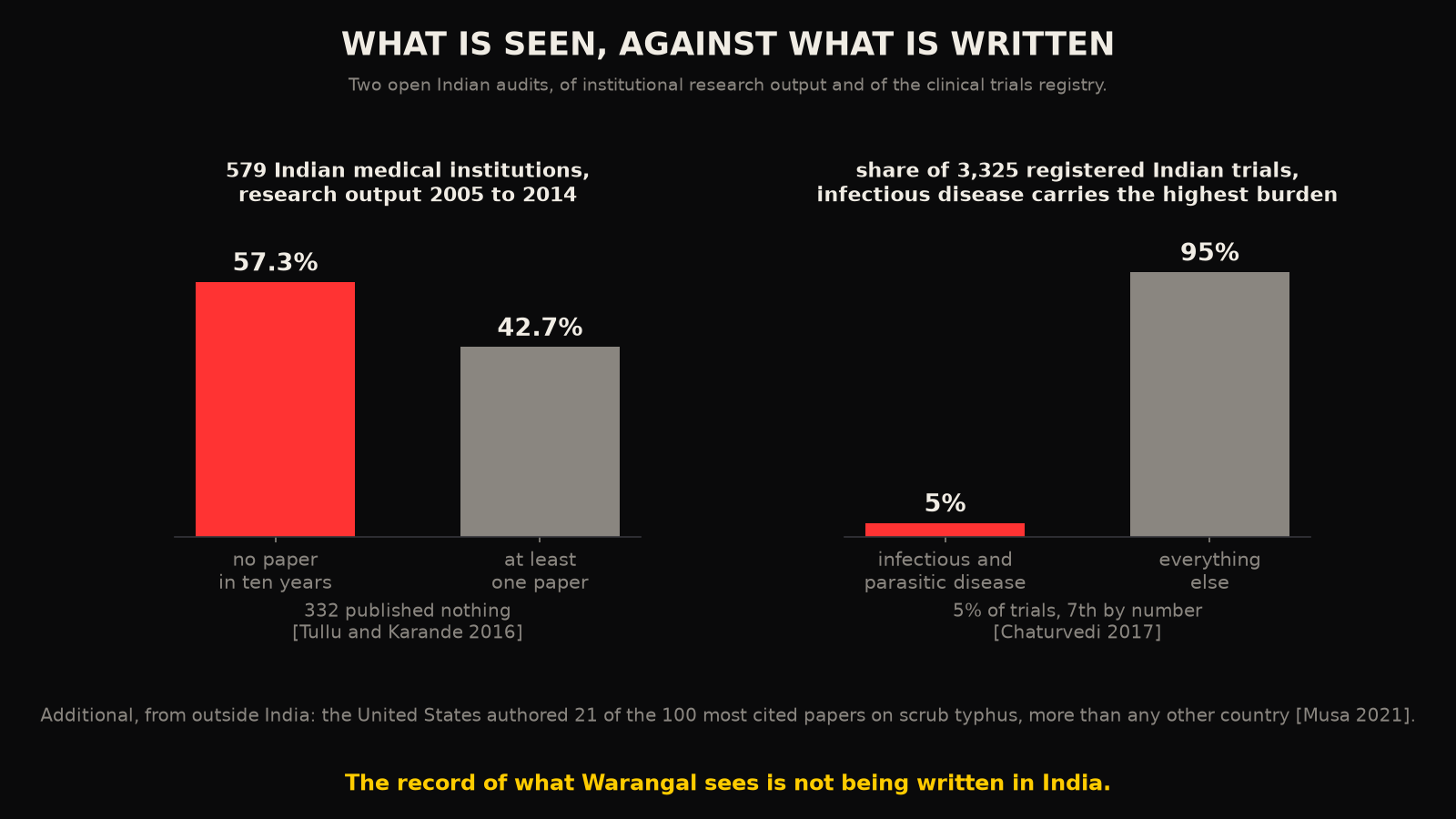
Think about the volume of clinical experience that passes through Indian hospitals in a single day. Now look at what comes out of it as literature. How much of what you saw on your last monsoon rotation exists anywhere in print? When the research output of 579 Indian medical institutions over the ten years from 2005 to 2014 was audited, 332 of them, 57.3 percent, had published no paper at all in the decade1. These are teaching hospitals. They have departments, residents and wards full of the diseases the rest of the world sees rarely.
The mismatch runs deeper than volume. When the Clinical Trials Registry of India was audited against the national burden of disease, infectious and parasitic diseases carried the highest burden by disability adjusted life years. They accounted for five percent of the registered trials and ranked seventh by number2. The diseases that fill the ICU in Warangal in the monsoon are the ones with the fewest trials. Even the literature that does exist on those diseases is largely written elsewhere. Of the hundred most cited papers on scrub typhus, a disease endemic across the Indian subcontinent, the United States authored 21, more than any other country3. The single journal with the most of them was the American Journal of Tropical Medicine and Hygiene3.
The form that could carry a bedside observation into the record is the case report. That form has been demoted. A review of its merits and limitations lists what it does that a trial cannot: detecting novelties, generating hypotheses, pharmacovigilance
, with high applicability where other designs are impossible4. The same review notes that the form lost its central place in the medical literature during the twentieth century4. The observation that organophosphate patients in a particular district need atropine for longer than the protocol allows is a case series waiting to be written. It is being seen four hundred times and written zero times. (If you trained in a district hospital you have one of these yourself. You have probably never typed it.)
2The pipeline was built when distribution was expensive
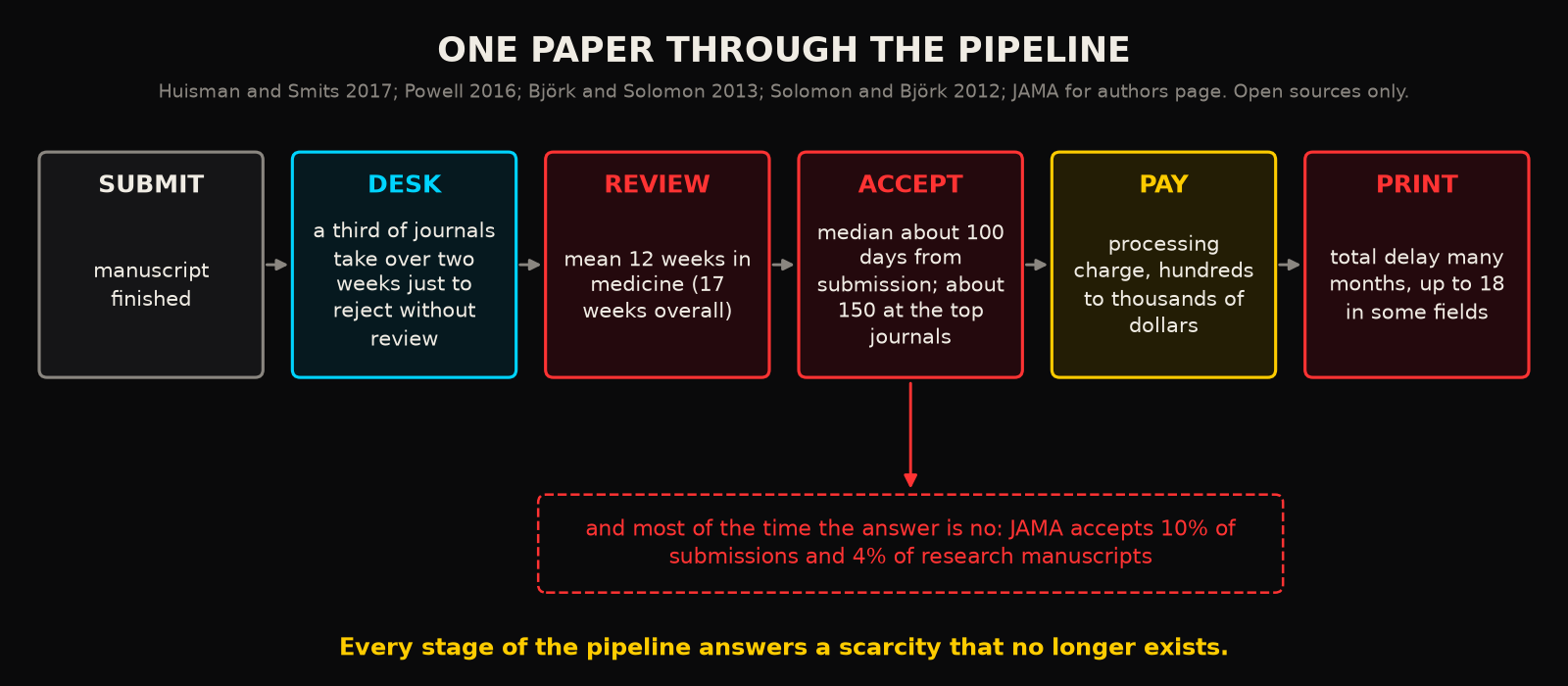
Suppose she decides to write it up. The road from a finished manuscript to a citable paper runs through a machine designed in the age of print. The problem is that the machine still runs at print speed. Across roughly 3,500 author reports, the review process alone for an accepted manuscript averaged seventeen weeks across all fields and twelve weeks in medicine5. A third of journals took more than two weeks just to reject a paper without review5. An analysis of every PubMed paper with recorded dates found that the median time from submission to acceptance has sat at around a hundred days for decades6. At the journals with the highest impact factors it is closer to 150. Nature's own median review time grew from 85 days to just above 150 over ten years6. Add the queue to print and the delay in science, technology and medicine runs to many months, and in some fields to a year and a half7.
Then it costs money. In 2010 the open access journals that charged authors a processing fee averaged several hundred dollars per article, with a range that ran to several thousand8. In the years since, the fees at the established journals have moved well into the thousands. A consultant in a tier two city is being asked to pay a month's salary (in a currency that is not hers) to have her case series read.
And then, most of the time, it is refused. JAMA states on its own page for authors that it accepts ten percent of more than 12,700 annual submissions9. For the more than 5,700 research manuscripts it receives, the figure is four percent9. The journals that count are built to say no. The paper a district ICU produces is the paper they are built to say no to: single centre, observational, about a disease the editors' readership does not treat. A rejection rate measures demand as well as judgement. It does not say whether the refused papers were wrong. It says they will not be read.
3What fills the gap
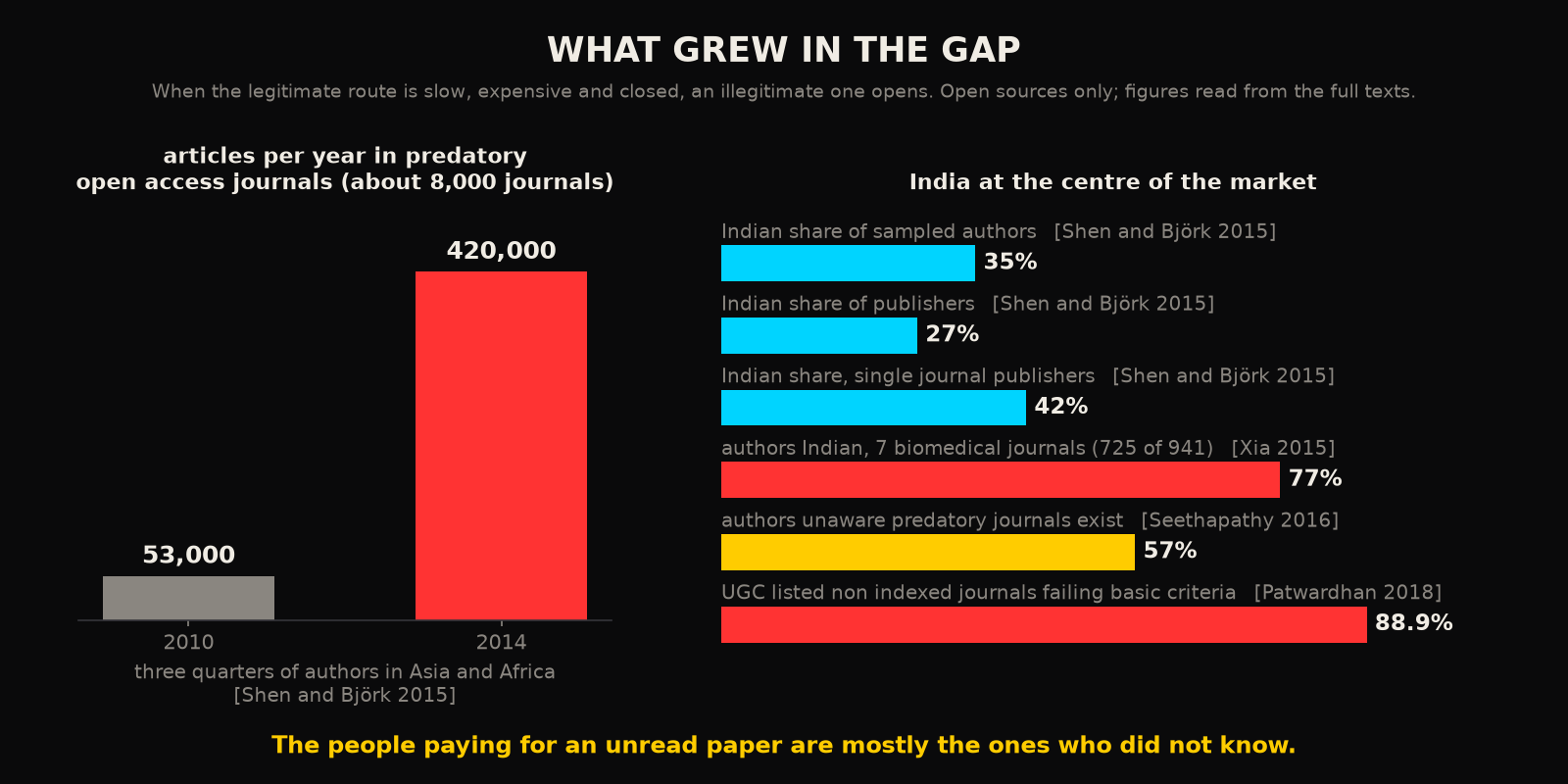
When a legitimate route is slow, expensive and closed, an illegitimate one opens. The size of the one that opened has been measured. The volume of articles in predatory open access journals grew from 53,000 in 2010 to an estimated 420,000 in 2014, across roughly 8,000 journals10. Three quarters of their authors were in Asia and Africa. In the same study around 35 percent of the sampled authors were Indian and 27 percent of the publishers were based in India10. In the stratum of single journal publishers the Indian share was 42 percent10. In a separate sample from seven predatory biomedical journals, 725 of 941 authors were Indian11.
The people paying are not the cynical. When 3,300 articles from 350 listed predatory journals were traced to their institutions, 51 percent came from private and government colleges12. When the corresponding authors were surveyed, 57 percent said they were unaware that predatory journals existed. Only 20 percent accepted that they had published in one unknowingly12. The regulator's own list did not help. Of 1,009 non indexed journals on the university source component of the UGC approved list, 34.5 percent gave incorrect or missing basic information and another 52.3 percent gave false information13. So 88.9 percent failed the minimal criteria13. Picture the customer: a young doctor in a college that needs publications for promotion, with no mentor who has navigated the real pipeline. The product is a paper that will never be read.
4Who decided
Step back from the numbers and the shape of the problem is clear. Basically, the journal pipeline was designed when distribution was the expensive part. Paper, postage, typesetting and shelf space were scarce, so a small number of editors had to decide what deserved them. Secrecy in review was a reasonable price for getting those editors to serve. Every feature that now looks like an obstacle, the queue, the fee, the anonymous reviewer, the rejection rate, was a sensible response to a scarcity that has gone. Distribution is free. A document can reach every intensivist in the country at no cost in the time it takes to send it. The pipeline has not noticed. This is exactly why knowledge that is being generated daily is being discarded daily: the only route to permanence still runs through a bottleneck built for a different century.
Who decided that a case seen four hundred times in Warangal counts for less than a case seen once in Boston? The scarcity decided, a long time ago. The reason has gone and the decision is still standing.
The part of the old machine that still does real work is review. Review does not require an editor in the middle or a reviewer in the dark. That has been tested. When the BMJ randomised reviewers to sign their reviews or stay anonymous, the quality scores were the same, 3.09 against 3.0614. The only cost was that more of the signed reviewers declined to take part14. When five Elsevier journals began publishing their review reports, across 9,220 submissions and 18,525 reviews, publishing the reports did not change referees' willingness to review, their recommendations or their turnaround times15. When eLife stopped issuing accept or reject decisions altogether and began publishing reviewed preprints with public assessments, it received more than 6,200 submissions and published more than 1,300 reviewed preprints in its first year16. It sent a similar fraction to review as under its old model16. Review in the open, by named people, works. The gap is that the clinicians who are not already inside the system have no place for it to happen. These studies were run inside journals with editors already in place, and none of them measured what open review does without that scaffolding. That is the part still to be shown.
5Somewhere for it to go
The tachyDx Research Portal exists for this problem, and its design follows from the argument above. A clinical question is raised and discussed among verified physicians. When it resolves, the resolved discussion becomes a paper with a digital object identifier, in days, with the reviewers named and every contributor credited. The reviewers are named because accountable review is the only kind that works without an editor in the middle. When the reviewer's name is on the record, the reviewer is the editor. What the portal gives the exception seen in Warangal is a permanent address that can be cited from anywhere. Speed is not rigour. The review checklist and the open names are the rigour, and the portal will be judged on the papers it produces.
6What retires with her
Back in Warangal, the monsoon admissions are starting. She is going to spend the next four months seeing diseases that the hundred most cited papers were mostly written about from somewhere else. She knows which patients are going to turn. She knows it before the numbers do. In nineteen years she has never been asked to write that down in a form that would survive her. Protocol medicine is going to inherit her unit. The protocol will have been written in a city where the authors have never treated a snakebite.
Next year she retires. Everything she knows goes with her, unless there is somewhere else for it to go.
RReferences
- 1.Tullu MS, Karande S. Quality research in Indian medical colleges and teaching institutions: the need of the hour. J Postgrad Med. 2016;62(4):213-215.
- 2.Chaturvedi M, Gogtay NJ, Thatte UM. Do clinical trials conducted in India match its healthcare needs? An audit of the Clinical Trials Registry of India. Perspect Clin Res. 2017;8(4):172-175.
- 3.Musa TH, Li W, Kawuki J, Wei P. The 100 top-cited articles on scrub typhus: a bibliometric analysis. Osong Public Health Res Perspect. 2021;12(2):126-135.
- 4.Nissen T, Wynn R. The clinical case report: a review of its merits and limitations. BMC Res Notes. 2014;7:264.
- 5.Huisman J, Smits J. Duration and quality of the peer review process: the author's perspective. Scientometrics. 2017;113(1):633-650.
- 6.Powell K. Does it take too long to publish research? Nature. 2016;530(7589):148-151. Free PDF.
- 7.Björk BC, Solomon D. The publishing delay in scholarly peer-reviewed journals. J Informetr. 2013;7(4):914-923. Author manuscript.
- 8.Solomon DJ, Björk BC. A study of open access journals using article processing charges. J Am Soc Inf Sci Technol. 2012;63(8):1485-1495. Author manuscript.
- 9.JAMA Network. For authors: about JAMA. Accessed October 2026.
- 10.Shen C, Björk BC. 'Predatory' open access: a longitudinal study of article volumes and market characteristics. BMC Med. 2015;13:230.
- 11.Xia J, Harmon JL, Connolly KG, et al. Who publishes in 'predatory' journals? J Assoc Inf Sci Technol. 2015;66(7):1406-1417. Author manuscript.
- 12.Seethapathy GS, Santhosh Kumar JU, Hareesha AS. India's scientific publication in predatory journals: need for regulating quality of Indian science and education. Curr Sci. 2016;111(11):1759-1764.
- 13.Patwardhan B, Nagarkar S, Gadre SR, et al. A critical analysis of the 'UGC-approved list of journals'. Curr Sci. 2018;114(6):1299-1303.
- 14.van Rooyen S, Godlee F, Evans S, Black N, Smith R. Effect of open peer review on quality of reviews and on reviewers' recommendations: a randomised trial. BMJ. 1999;318(7175):23-27.
- 15.Bravo G, Grimaldo F, López-Iñesta E, Mehmani B, Squazzoni F. The effect of publishing peer review reports on referee behavior in five scholarly journals. Nat Commun. 2019;10:322.
- 16.eLife. eLife's new model: one year on. Inside eLife, 2024.
Declarations
Competing interests. The author is the founder of Aethryva Deeptech, which develops the tachyDx platform and the MOISSCode language. Where an article in this series mentions either, it says so in the text and the mention follows the argument.
Sources and figures. Every reference in this article is an open access source that any reader can open without payment. The figures were drawn by the author from the values printed in those sources, or are labelled as schematic where no published value exists. No patient data were used.
Cite this article
Kunche N. The best intensivist in your city will retire with twenty years of unwritten cases. The Intervention. 22 October 2026. https://nikhilkunche.com/blog/the-best-intensivist-in-your-city-will-retire-with-twenty-years-of-unwritten-cases
Comments