
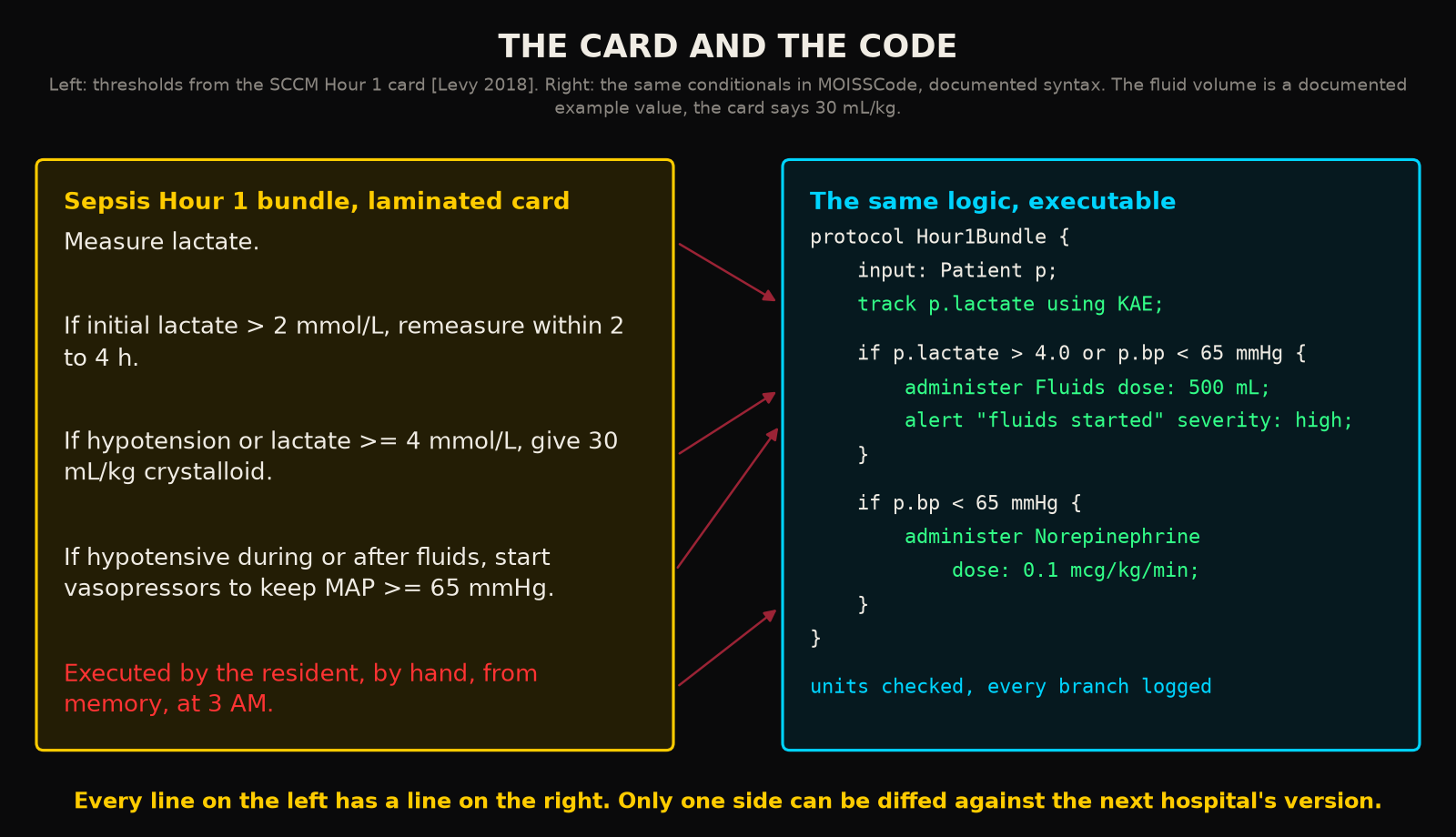
It is three in the morning in a district hospital and the resident on call has a laminated card in the pocket of her coat. The card says that if the lactate is above four, or the pressure is low, she is to give thirty millilitres of crystalloid per kilogram. It says to remeasure the lactate within two to four hours if the first one was above two. It says that if the pressure stays below a mean of 65 after the fluid, she is to start a vasopressor1. She has read it a hundred times. Tonight she is reading it against a 54 kilogram woman with a lactate of 4.6, a pressure she has already checked twice, and a pump she has to programme herself.
Look at what the card is. It is a conditional. Inside the conditional there is a loop with an exit condition. There is a lookup against body weight, a threshold comparison, a timed reassessment and a branch. Every element of it has a name in computer science. None of it has ever been run by a computer. The resident is the interpreter. She is executing the program by hand, from memory, at the hour of the night when interpreters make the most mistakes, and she is doing it while she does everything else.
You carry the same thing: the vancomycin nomogram taped above the pharmacy hatch, the Child Pugh table on the hepatology ward, the insulin sliding scale on every surgical bed. Clinicians have been writing formal logic for decades. They write it in tables and flowcharts and sentences with the word if in them, and then they run it on themselves.
1The same protocol in five places
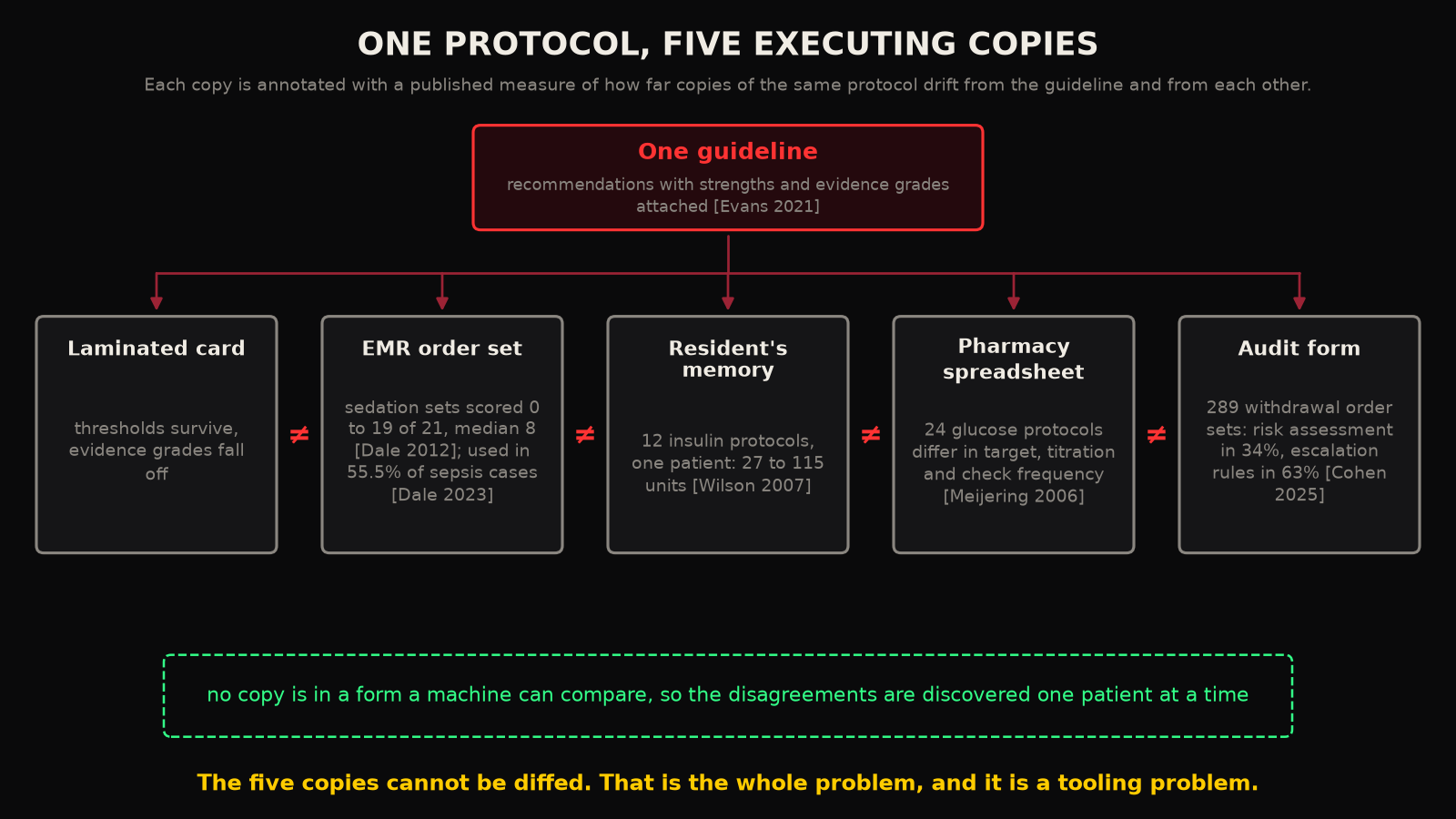
A program that only exists on paper has a specific failure mode. It gets copied, and the copies drift. The sepsis bundle on the resident's card is also an order set in the electronic record, a version in the consultant's memory, a column in the pharmacist's spreadsheet and a checklist on the audit form. The team cannot line the five of them up to see where they disagree (the audit form, which exists to catch this, is itself one of the five). The guideline that produced the card is itself a program of recommendations with strengths and qualities of evidence attached. Thirty millilitres per kilogram within three hours is a weak recommendation on low quality evidence. Antimicrobials within an hour of recognising septic shock is a strong one2. By the time it is laminated, the weights have fallen off and only the thresholds survive.
The drift has been measured. When twelve published intensive insulin protocols were applied to a single hyperglycaemic patient, the recommended dose ranged from 27 to 115 units, a mean of 66.7 with a standard deviation of 27.93. The same inputs, the same intent, a four fold spread in the output. A systematic review of twenty four glucose control protocols found that they differed in target range, in titration method and in how often the glucose was to be checked4. The dynamic protocols using the last two glucose values performed best. That is a statement about an algorithm. It was reached by reading twenty four prose documents side by side, because there was no other way to compare them.
Order sets, which are supposed to be the executable form, drift just as far. Fifty one hospitals in Washington State were scored on their sedation order sets against the twenty one elements of the guideline they were built from5. The scores ran from 0 to 19, with a median of 8. In a library of 289 alcohol withdrawal order sets from 95 organisations, a risk assessment for severe withdrawal was present in 34 percent, escalation criteria in 63 percent, and the definitions of both were inconsistent across the sets6. When the order set is used it helps. Across 104,662 sepsis patients in 54 hospitals the set was used in 55.5 percent of cases, and those patients had a shorter time to antibiotics, 125 against 179 minutes, with an adjusted odds of death of 0.707. Four in nine patients never had the program run at all.
This is exactly why bundle compliance figures look the way they do. Across 1,794 patients in 62 countries, the three hour bundle was completed in 19 percent of cases and the six hour bundle in 36 percent8. Finishing them was associated with lower mortality, 20 against 31 percent. Over 29,470 patients and seven and a half years, hospitals with high adherence to the resuscitation bundle had a mortality of 29.0 percent against 38.6 percent at low adherence sites9. The program works when it runs. It mostly does not run, because the interpreter is a person with twenty other things to do.
Even the arithmetic is unsafe by hand. In an ambulatory chemotherapy service, 3 percent of 10,112 orders contained a medication error10. Of the adult errors, 82 percent had the potential for harm, and only 45 percent of the potentially harmful ones were intercepted before they reached the patient. Chemotherapy dosing is a function of body surface area, renal function and a lookup table. It is a program. It was being run on paper.
2Thirty years of compilers that never shipped
Informatics noticed all this a long time ago and did the obvious thing. It built languages. Arden Syntax was standardised in the 1990s for encoding medical logic as modules a hospital could share11. The modules did not travel. Every query for patient data inside an Arden module was written ad hoc, inside curly braces, in whatever form the local hospital's database required. An analysis of 488 queries across 104 modules at one institution found that this nonstandard representation was exactly what impaired sharing12. The logic was portable. The data was stuck where it was. Basically a protocol without data is a card.
The field kept trying. Asbru gave guidelines a time oriented skeleton with intentions and plans13. PROforma defined a process modelling language with formal operational semantics14. GLIF3 was published as a sharable representation and, in its own authors' words, ready for broader experimentation and prototype use15. When six of these models were made to encode the same two guidelines, they agreed on how to organise a plan and disagreed on decision models, goals, scenarios and structured actions16. Then came a twelve step method for marking up a guideline document, disambiguating it, and extracting executable rules17. The decade turned. By 2013 a methodological review was cataloguing modelling languages, execution engines, exception handling and the implementation barriers between them18. By 2018 the field's own leaders were writing that clinical decision support had been developed for over five decades and still lacked wide adoption. They blamed weak leadership, unclear purpose, inattention to workflow, and proprietary systems that could not talk to each other19. The newest attempt expresses measures in CQL against FHIR data, and the published work is still at the proof of concept stage20.
Why did none of it stick? Read the languages and the answer is on the page. Each of them was designed for the informatician who would encode the guideline on the clinician's behalf. The clinician was the subject matter expert, interviewed and then dismissed. Every language asked her to learn the computer's vocabulary before she could write down what she already knew. Her card needed no vocabulary at all. The card won every time, because the card could be read at three in the morning.
3What happens when the logic runs
When the program does run on a machine, the effect is real and it is modest. Both halves of that matter. Across seventy trials, decision support significantly improved clinical practice in 68 percent21. Of the 32 systems that delivered support automatically, inside the workflow, at the time and place of the decision, with a recommendation attached, 30 improved practice. Across 122 trials and 1.2 million patients, the absolute improvement in the proportion of patients receiving the intended care was 5.8 percent22. The top quartile of systems achieved between 10 and 62 percent. The clinical endpoints moved by a median of 0.3 percent. That is what the logic looks like when it executes: a reliable few percent, and occasionally a lot. I will be plain about the limit here. Those trials measured process. The gap between a process improving and a patient surviving is wide.
The failure mode is also known. When the executable protocol is reduced to a popup, clinicians override it between 49 and 96 percent of the time23. Acceptance falls by 30 percent with every additional reminder in the same encounter24. An alert is what you get when the protocol's output is delivered without its reasoning. The resident ignores it for the same reason she trusts the card. The card shows its logic. The popup hides it.
Put those findings together and the specification writes itself. The protocol must be written by the person who owns it, in her nouns. It must execute automatically, at the bedside, with its reasoning visible. It must be in a form that two hospitals can compare line by line, so that the four fold spread in insulin dosing becomes a diff. The units must be checked, because a program that lets milligrams be compared with millimoles is a program that will one day do it. The same conclusion has been reached independently in veterinary medicine. A domain specific language was built there so that the clinicians themselves, and no longer the coding experts, could write the protocols for chronic kidney disease in cats25. The nouns had to be the clinician's nouns. That was the whole design.
4A language whose nouns are the clinician's nouns
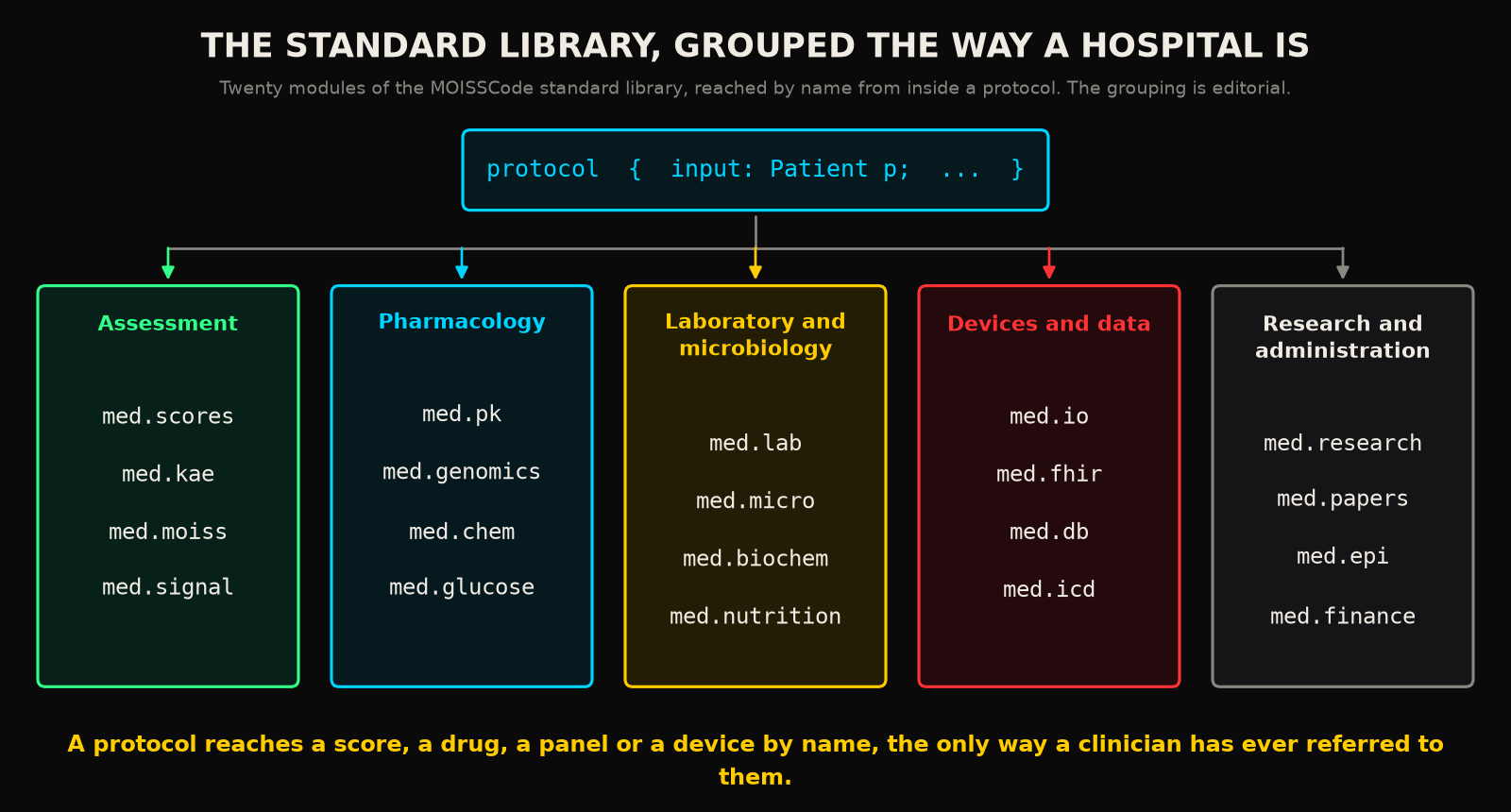
This is what MOISSCode was built to be. It is an open source language in which a protocol is declared as a protocol, takes a patient as its input, and is written in the vocabulary of the card: if the lactate is above four, administer fluids, alert the team, track the lactate. Units are part of the type system, so a pressure cannot be compared with a mass and the program will refuse to run until the mistake is fixed. A protocol reaches a validated score, a drug, a laboratory panel or a device by name, the way a clinician has always referred to them. The bundle from the resident's card, written in it, is a dozen lines. Those dozen lines can be diffed against the next hospital's dozen, which is the comparison the laminated card never allowed.
protocol Hour1Bundle {
    input: Patient p;

    track p.lactate using KAE;

    if p.lactate > 4.0 or p.bp < 65 mmHg {
        administer Fluids dose: 500 mL;
        alert "Sepsis bundle: fluids started" severity: high;
    }

    if p.bp < 65 mmHg {
        administer Norepinephrine dose: 0.1 mcg/kg/min;
        alert "MAP below target after fluids" severity: critical;
    }
}
A language does not validate a protocol. What it does is make the protocol legible enough to be argued with.
5The interpreter in the building
Go back to the resident at three in the morning. She has protocols. She has evidence that they work when they are followed, because the bundle papers show the mortality difference plainly. What she lacks is an interpreter. The card cannot check her arithmetic. It cannot remind her at the two hour mark. It cannot tell her that the version she memorised last year was revised in March. Tomorrow it will not be able to show the audit team which branch she took and why. It is a program with no runtime. She is the runtime.
The protocols were always code. They were just being run on the most expensive and least reliable interpreter in the building.
RReferences
- 1.Levy MM, Evans LE, Rhodes A. The Surviving Sepsis Campaign bundle: 2018 update. Crit Care Med. 2018;46(6):997-1000.
- 2.Evans L, Rhodes A, Alhazzani W, et al. Surviving Sepsis Campaign: international guidelines for management of sepsis and septic shock 2021. Intensive Care Med. 2021;47:1181-1247.
- 3.Wilson M, Weinreb J, Hoo GW. Intensive insulin therapy in critical care: a review of 12 protocols. Diabetes Care. 2007;30(4):1005-1011.
- 4.Meijering S, Corstjens AM, Tulleken JE, et al. Towards a feasible algorithm for tight glycaemic control in critically ill patients: a systematic review of the literature. Crit Care. 2006;10(1):R19.
- 5.Dale CR, Hayden SJ, Treggiari MM, et al. Association between hospital volume and network membership and an analgesia, sedation and delirium order set quality score: a cohort study. Crit Care. 2012;16(3):R106.
- 6.Cohen SM, Kashyap N, Steel TL, et al. Guideline concordance of electronic health record order sets for hospital-based treatment of alcohol withdrawal syndrome. J Hosp Med. 2025;20(6):550-561. Author manuscript.
- 7.Dale CR, Schoepflin Sanders S, Chang SC, et al. Order set usage is associated with lower hospital mortality in patients with sepsis. Crit Care Explor. 2023;5(5):e0918.
- 8.Rhodes A, Phillips G, Beale R, et al. The Surviving Sepsis Campaign bundles and outcome: results from the International Multicentre Prevalence Study on Sepsis (the IMPreSS study). Intensive Care Med. 2015;41(9):1620-1628. Author accepted manuscript.
- 9.Levy MM, Rhodes A, Phillips GS, et al. Surviving Sepsis Campaign: association between performance metrics and outcomes in a 7.5-year study. Intensive Care Med. 2014;40(11):1623-1633.
- 10.Gandhi TK, Bartel SB, Shulman LN, et al. Medication safety in the ambulatory chemotherapy setting. Cancer. 2005;104(11):2477-2483.
- 11.Samwald M, Fehre K, de Bruin J, Adlassnig KP. The Arden Syntax standard for clinical decision support: experiences and directions. J Biomed Inform. 2012;45(4):711-718.
- 12.Jenders RA, Sujansky W, Broverman CA, Chadwick M. Towards improved knowledge sharing: assessment of the HL7 Reference Information Model to support medical logic module queries. Proc AMIA Annu Fall Symp. 1997:308-312.
- 13.Shahar Y, Miksch S, Johnson P. The Asgaard project: a task-specific framework for the application and critiquing of time-oriented clinical guidelines. Artif Intell Med. 1998;14(1-2):29-51.
- 14.Sutton DR, Fox J. The syntax and semantics of the PROforma guideline modeling language. J Am Med Inform Assoc. 2003;10(5):433-443.
- 15.Boxwala AA, Peleg M, Tu S, et al. GLIF3: a representation format for sharable computer-interpretable clinical practice guidelines. J Biomed Inform. 2004;37(3):147-161.
- 16.Peleg M, Tu S, Bury J, et al. Comparing computer-interpretable guideline models: a case-study approach. J Am Med Inform Assoc. 2003;10(1):52-68.
- 17.Shiffman RN, Michel G, Essaihi A, Thornquist E. Bridging the guideline implementation gap: a systematic, document-centered approach to guideline implementation. J Am Med Inform Assoc. 2004;11(5):418-426.
- 18.Peleg M. Computer-interpretable clinical guidelines: a methodological review. J Biomed Inform. 2013;46(4):744-763.
- 19.Greenes RA, Bates DW, Kawamoto K, et al. Clinical decision support models and frameworks: seeking to address research issues underlying implementation successes and failures. J Biomed Inform. 2018;78:134-143.
- 20.Lin AM, Schwab A, Abolhassni R, Winkler S. From authoring to evaluating an electronic health quality measure: applying logic to FHIR with CQL for calculating immunization coverage. Stud Health Technol Inform. 2023;301:12-17.
- 21.Kawamoto K, Houlihan CA, Balas EA, Lobach DF. Improving clinical practice using clinical decision support systems: a systematic review of trials to identify features critical to success. BMJ. 2005;330(7494):765.
- 22.Kwan JL, Lo L, Ferguson J, et al. Computerised clinical decision support systems and absolute improvements in care: meta-analysis of controlled clinical trials. BMJ. 2020;370:m3216.
- 23.van der Sijs H, Aarts J, Vulto A, Berg M. Overriding of drug safety alerts in computerized physician order entry. J Am Med Inform Assoc. 2006;13(2):138-147.
- 24.Ancker JS, Edwards A, Nosal S, et al. Effects of workload, work complexity, and repeated alerts on alert fatigue in a clinical decision support system. BMC Med Inform Decis Mak. 2017;17:36.
- 25.Meacham S, Alfraihi H. Towards democratisation of veterinary clinical protocols: transferring their development from technical-coding experts to veterinary professionals for the case of chronic kidney disease for cats (CKD4Cats domain-specific language). J Comput Lang. 2025;84:101328.
Declarations
Competing interests. The author is the founder of Aethryva Deeptech, which develops the tachyDx platform and the MOISSCode language. Where an article in this series mentions either, it says so in the text and the mention follows the argument.
Sources and figures. Every reference in this article is an open access source that any reader can open without payment. The figures were drawn by the author from the values printed in those sources, or are labelled as schematic where no published value exists. No patient data were used.
Cite this article
Kunche N. A clinical protocol is a program that has never been compiled. The Intervention. 22 May 2026. https://nikhilkunche.com/blog/a-clinical-protocol-is-a-program-that-has-never-been-compiled
Comments