
It is a little after nine in the evening and a daughter is standing at the door of bed 4. Her father has been there for three days with a liver that is failing. He was talking at the morning round. Now he is picking at the sheet and he does not know what day it is, and she has watched enough of this unit to know what that change can mean. She finds the registrar and asks for a repeat ammonia and a blood gas. The registrar is kind about it, and tired, and gives the answer that registrars everywhere give: the panel is due at six, the ammonia was drawn this morning, and there will be no meaningful change in that interval.
The sentence is delivered as a fact about the patient. The daughter hears it as one. You have said it yourself, probably this week. It is worth taking apart slowly, because it is among the commonest sentences spoken in a hospital and almost nothing in it is about the man in bed 4.
1Where the six o'clock draw came from
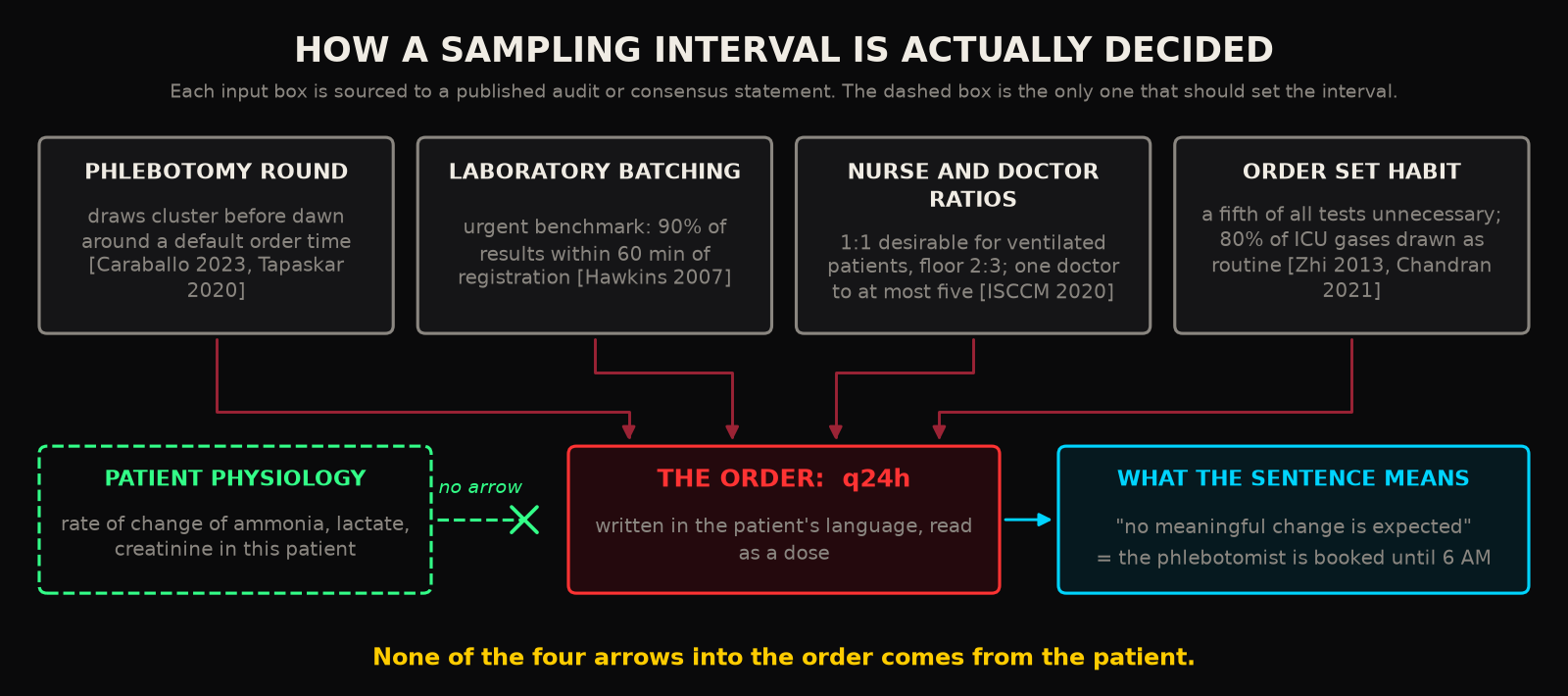
Ask why the panel is due at six and the honest answers arrive in a particular order. The phlebotomy round starts before dawn so the results are back for the consultant's round. The laboratory batches its chemistry. The night shift has fewer hands. The order set defaulted to a daily frequency when somebody built it a decade ago, and since then there has been no reason to open it. Every one of those answers is true. Every one of them is a fact about labour, instruments and habit. When the American critical care societies wrote their list of five things intensivists should stop doing, the first item on it was this exact timetable: do not order diagnostic tests at regular intervals (such as every day), but rather in response to specific clinical questions
1. They did not need to explain what regular intervals meant. Everyone on the unit already knew.
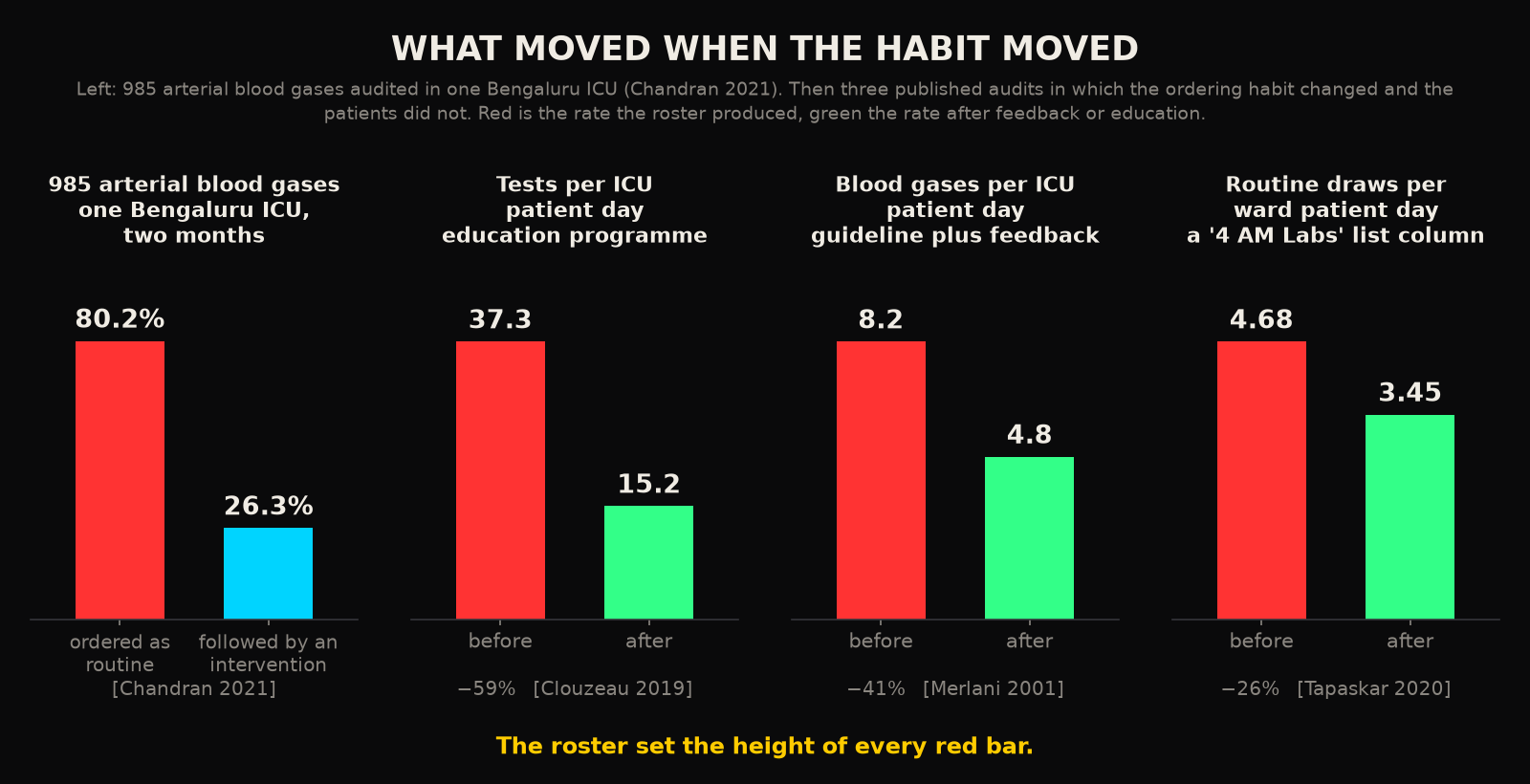
The scale of the habit is on record. A fifteen year meta analysis of laboratory testing found that about a fifth of all tests ordered were unnecessary by the literature's own criteria2. Overuse during initial testing, at 43.9 percent, ran six times higher than during repeat testing. Laboratory testing, the same review notes, is the single highest volume medical activity there is. At one large academic centre, draws were found to cluster in the hours before dawn, around the hospital's default order time3. On general medical wards elsewhere, adding a column headed 4 AM Labs to the electronic patient list, so that the team could see the habit, cut routine draws from 4.68 to 3.45 per patient day, a fall of 26.3 percent4. Nothing about the patients was altered. A column was added to a screen.
Then the sample has to travel. The common benchmark for an urgent laboratory is that nine in ten results are reported within sixty minutes of registration5, so the two points a day that the schedule allows are each an hour or more old by the time anyone reads them. The daughter is asking about her father at nine in the evening. The last number anyone holds was drawn fifteen hours ago and reported fourteen hours ago.
2The roster is the real order set
In India the staffing layer is explicit. The Indian Society of Critical Care Medicine's planning consensus says that one nurse to one ventilated patient is desirable and that the ratio must in no circumstance fall below two nurses to three such patients6. One nurse to two or three patients is acceptable for the less sick. A single doctor should not be managing more than five critically ill patients at once. Those are the norms. The second national case mix study described the units they apply to: 132 ICUs, 4,669 adult patients, an ICU mortality of 23.4 percent7. The distribution of trained intensivists and ICU nurses between cities and districts is described in the recent literature as stark, with shortages extending to nursing and ancillary staff8.
Put the two together and the sampling interval is being decided by arithmetic that has nothing to do with physiology. A nurse with three patients and one arterial line among them can draw and run a gas every hour on one of them, or every few hours on all of them. She is the one who will be standing at the analyser. A registrar covering twenty beds can review a result every hour on one bed or once a day on twenty. If that registrar is you, you already know which one it is going to be. Somebody has to decide. The decision is made where it is always made, in the roster, well before the patient arrives.
What makes this hard to see is that the roster's decision is written into the chart in the patient's language. The order says q24h. On a chart q24h looks like a dose. It reads as though someone computed how fast this liver could change and concluded that a day was enough (presumably with a stopwatch and a reason). That number was never computed. The day was what the night shift could carry.
3What happens when the habit moves
If the interval were physiology, it would be stable across hospitals and resistant to education. It is neither. In a French ICU, a programme aimed at the appropriateness of test ordering took the rate from 37.3 to 15.2 tests per patient day and cut the cost from 239 to 104 euros per patient day9. The effect was still present a year on, with the control unit unchanged. In Geneva, linking a blood gas guideline to regular feedback took arterial gases from 8.2 to 4.8 per patient day10. In Bengaluru, an audit of 985 arterial gases over two months found that 790 of them, 80.2 percent, had been ordered as routine with no specific indication11. Only 26.29 percent of all those gases were followed by any intervention. Each of these units was certain, before the audit, that it was sampling at the rate the patients required.
The lesson is uncomfortable because it points in two directions at once. The schedule is oversampling the stable patient. This is exactly why these programmes save money without harming anyone. The same schedule is undersampling the patient who is changing. That is the daughter at the door. The habit is wrong in both directions for the same reason. It is a single number applied to a unit full of different clocks. One limit on these audits: they counted the tests that could be dropped and did not go looking for the deteriorations the schedule missed.
4The sentence that cannot be wrong
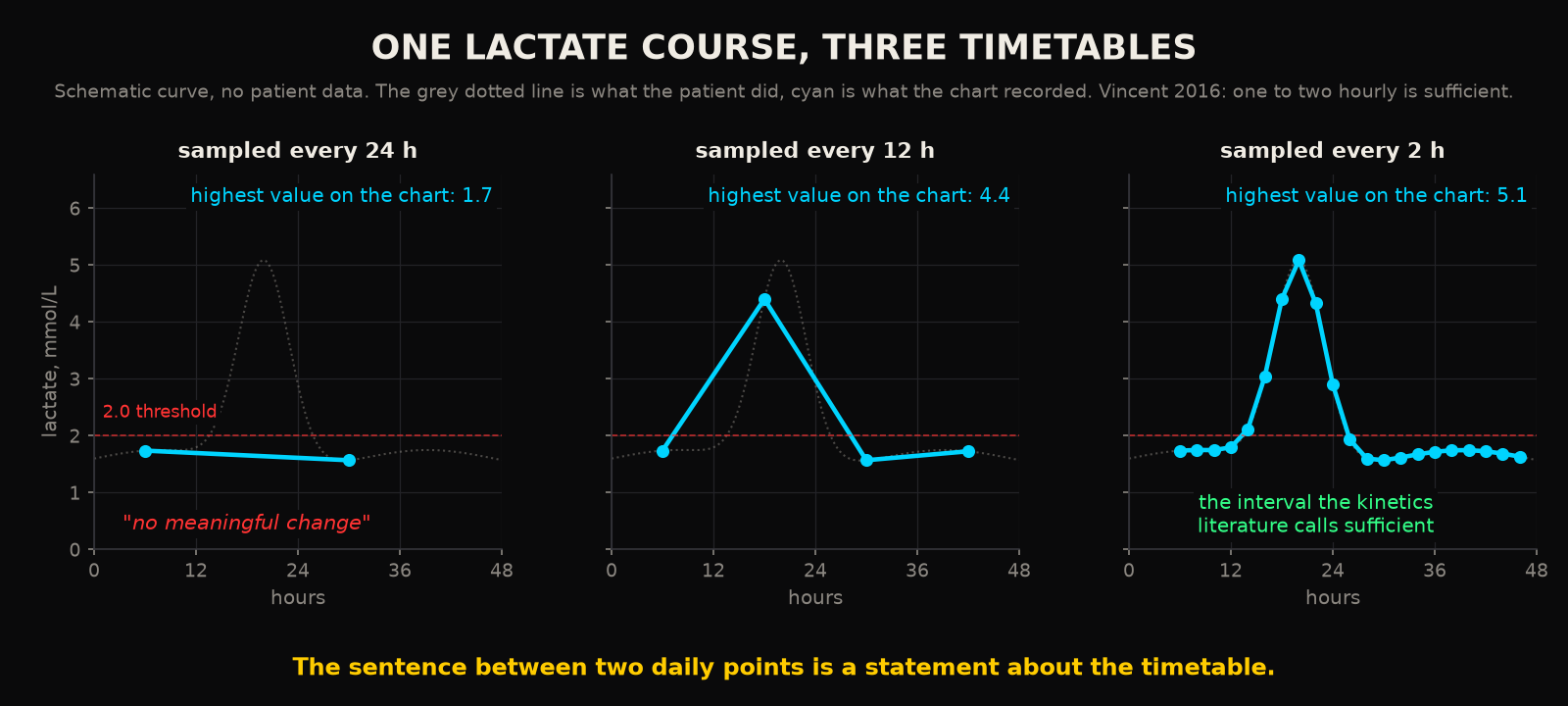
Return to the registrar's answer. No meaningful change is expected in the interval. What would it take for that sentence to be false? It would take a measurement inside the interval showing a change. The schedule guarantees there will be none. So the sentence is being tested only by the next scheduled draw. If the six o'clock ammonia is higher the explanation will be that the patient deteriorated overnight. If it is the same the explanation will be that the registrar was right. There is no outcome in which the sentence is caught out (a flat line between two daily points is the shape of every chart that is drawn once a day), because the sentence and the schedule are the same object. It is a statement about the sampling interval wearing the costume of a statement about the patient.
The costume is convincing because clinicians say it in the physiological voice. Consider lactate, which the literature treats as one of the faster signals in shock. The systematic review of lactate kinetics concludes that measurements every one to two hours are probably sufficient in most acute conditions12. Even that interval is routinely missed. In one needs assessment, the repeat lactate was the bundle element most often skipped, absent in 52.6 percent of severe sepsis cases and 60 percent of septic shock13. A signal the literature wants every hour or two is being read once or twice a day. The gap is being described, at the bedside, as stability.
The same thing is true of the reference analytes themselves. In 196 children after cardiopulmonary bypass, half developed kidney injury14. The diagnosis by serum creatinine was delayed by two to three days. Urine NGAL had risen fifteen fold within two hours of the injury, with an area under the curve of 0.95 at the two hour mark. A daily creatinine, in other words, is confirming the kidney of two days ago. It is yesterday's patient, written up as today's. A systematic review of 31 studies on how deterioration gets noticed found the recognition process repeatedly undermined by physiological parameters that were simply not recorded15. Delayed calls for help were strongly associated with unplanned ICU admission, length of stay and mortality. The invisible windows between draws are where that delay lives.
5Protocol medicine
Medicine that is executed according to the roster has a name. I call it protocol medicine. The protocol is written in advance, by people who will not be there, for a patient who has not arrived. It is written for the average of the unit because that is the only patient the roster can plan for. Its great virtue is that it runs without a decision. Its great flaw is the same thing. Who decided that every patient in the unit changes at the same rate, and on what evidence? The honest answer is that the rate was never decided and the evidence does not exist. The interval was never a hypothesis anyone proposed. It was a consequence of how many hands there were on the night shift, and every order set since has inherited it.
None of this is an argument against the registrar, who is doing exactly what the system asks and has twenty other beds. It is an argument about what the sentence is made of. The patient in bed 4 does not know what the roster is. His ammonia is rising or it is falling, at whatever rate a failing liver sets. The only thing the schedule can tell his daughter is when the next person with a syringe will be free.
The schedule will keep being right about itself and wrong about the patient, until the schedule stops being a variable.
RReferences
- 1.Halpern SD, Becker D, Curtis JR, et al. An official ATS/AACN/ACCP/SCCM policy statement: the Choosing Wisely top 5 list in critical care medicine. Am J Respir Crit Care Med. 2014;190(7):818-826. Official PDF.
- 2.Zhi M, Ding EL, Theisen-Toupal J, Whelan J, Arnaout R. The landscape of inappropriate laboratory testing: a 15-year meta-analysis. PLoS One. 2013;8(11):e78962.
- 3.Caraballo C, Mahajan S, Murugiah K, et al. Timing of blood draws among patients hospitalized in a large academic medical center. JAMA. 2023;329(3):255-257. Author manuscript.
- 4.Tapaskar N, Kilaru M, Puri TS, et al. Evaluation of the Order SMARTT: an initiative to reduce phlebotomy and improve sleep-friendly labs on general medicine services. J Hosp Med. 2020;15(8):479-482.
- 5.Hawkins RC. Laboratory turnaround time. Clin Biochem Rev. 2007;28(4):179-194.
- 6.Rungta N, Zirpe KG, Dixit SB, et al. Indian Society of Critical Care Medicine experts committee consensus statement on ICU planning and designing, 2020. Indian J Crit Care Med. 2020;24(Suppl 1):S43-S60.
- 7.Divatia JV, Mehta Y, Govil D, et al. Intensive care in India in 2018-2019: the second Indian intensive care case mix and practice patterns study (INDICAPS-II). Indian J Crit Care Med. 2021;25(10):1093-1107.
- 8.Sandal S, Himral S, Sharma JB, Mahajan K. From training to practice: addressing the realities of critical care subspecialty in rural India. J Emerg Trauma Shock. 2026.
- 9.Clouzeau B, Caujolle M, San-Miguel A, et al. The sustainable impact of an educational approach to improve the appropriateness of laboratory test orders in the ICU. PLoS One. 2019;14(5):e0214802.
- 10.Merlani P, Garnerin P, Diby M, Ferring M, Ricou B. Linking guideline to regular feedback to increase appropriate requests for clinical tests: blood gas analysis in intensive care. BMJ. 2001;323(7313):620-624.
- 11.Chandran J, D'Silva C, Sriram S, Krishna B. Clinical utility of arterial blood gas test in an intensive care unit: an observational study. Indian J Crit Care Med. 2021;25(2):172-175.
- 12.Vincent JL, Quintairos e Silva A, Couto L, Taccone FS. The value of blood lactate kinetics in critically ill patients: a systematic review. Crit Care. 2016;20(1):257.
- 13.Davino T, et al. Educational needs assessment identifying opportunities to improve sepsis care. BMJ Open Qual. 2022.
- 14.Bennett M, Dent CL, Ma Q, et al. Urine NGAL predicts severity of acute kidney injury after cardiac surgery: a prospective study. Clin J Am Soc Nephrol. 2008;3(3):665-673.
- 15.Difonzo M. Performance of the afferent limb of rapid response systems in managing deteriorating patients: a systematic review. Crit Care Res Pract. 2019;2019:6902420.
Declarations
Competing interests. The author is the founder of Aethryva Deeptech, which develops the tachyDx platform and the MOISSCode language. Where an article in this series mentions either, it says so in the text and the mention follows the argument.
Sources and figures. Every reference in this article is an open access source that any reader can open without payment. The figures were drawn by the author from the values printed in those sources, or are labelled as schematic where no published value exists. No patient data were used.
Cite this article
Kunche N. Models are learning the ward's sampling routine as if it were physiology. The Intervention. 7 May 2026. https://nikhilkunche.com/blog/models-are-learning-the-wards-sampling-routine-as-physiology
Comments