
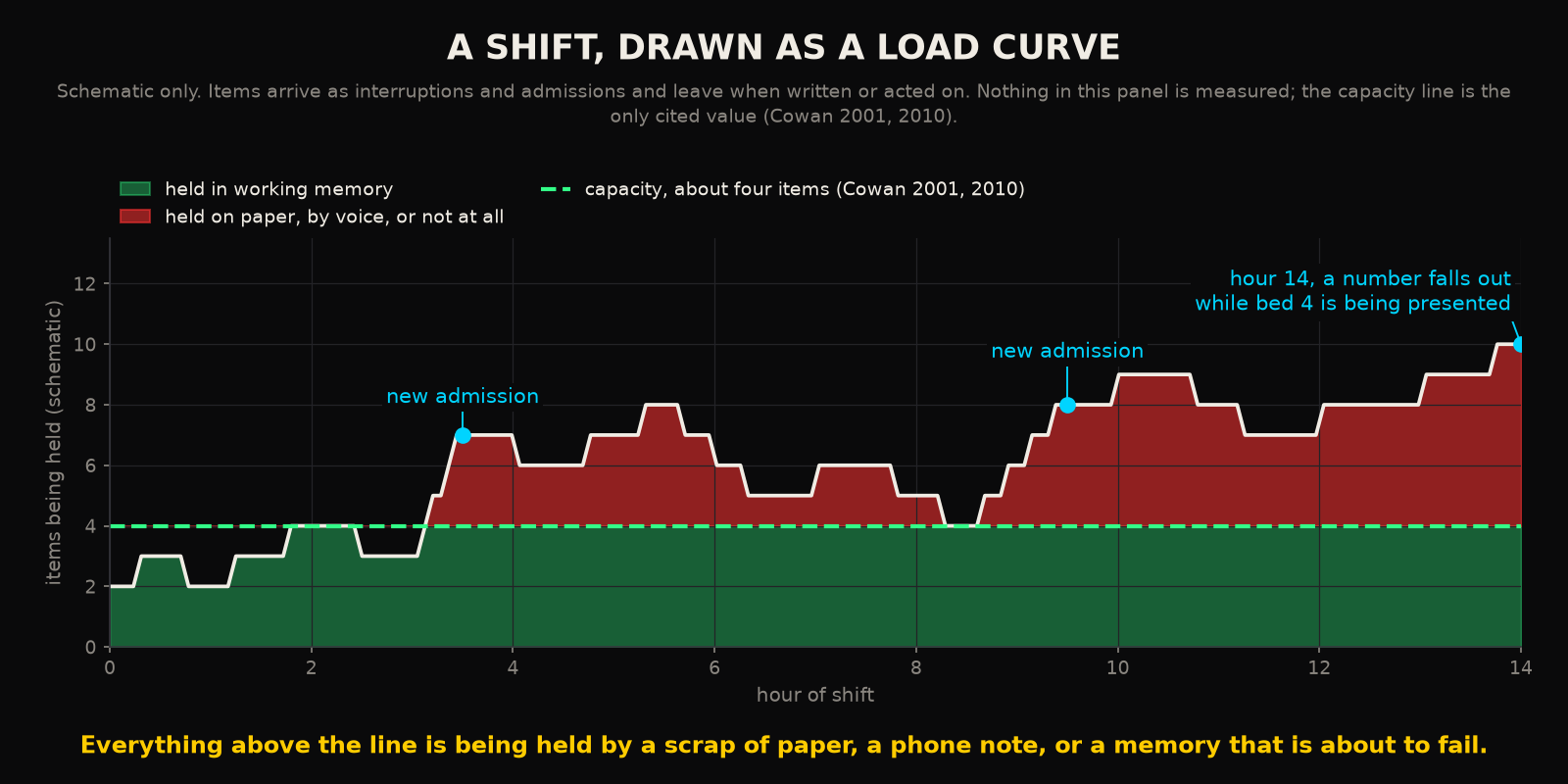
Hour fourteen of the shift. Twelve beds, two of them new since lunch. The resident is presenting bed 4 at the end of the row and you are listening to him with about a third of your attention. The other two thirds are busy. Bed 9 had a potassium of 2.9 at the afternoon gas and you have not seen the recheck. Bed 2 is on noradrenaline, the dose was going up at your last glance, and you do not know whether it is still going up. Bed 11's family was supposed to be told about the scan and you cannot remember whether the registrar did it before he left. None of this is written in the place where you are standing. All of it is in your head. The resident has just said a number about bed 4, and you did not hear it.
You are good at this. That is the problem. The unit is running because a person with a decade of training is holding it in a store that cognitive science measured a long time ago. The measurement was unkind.
1The store is small and it has been measured
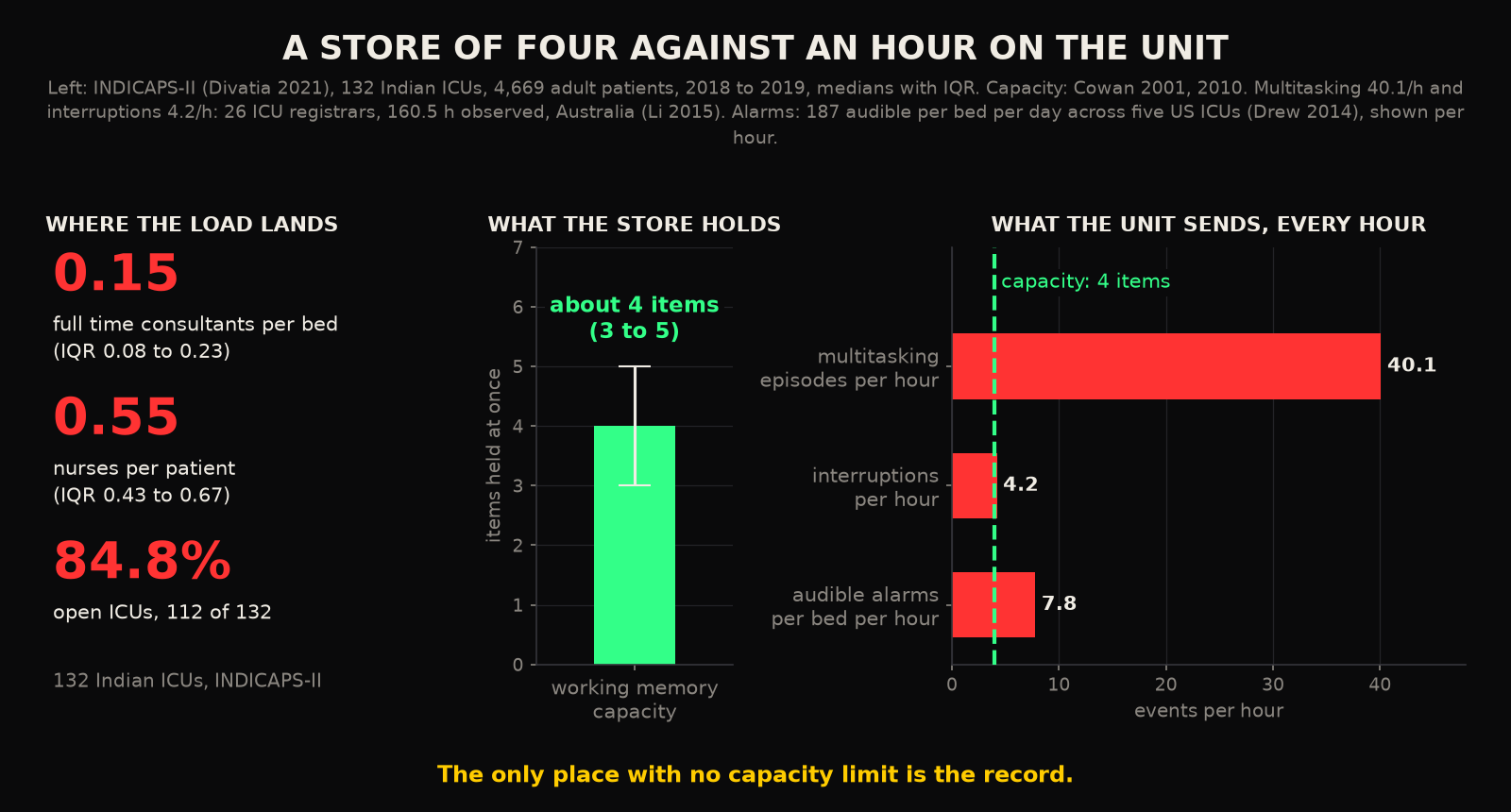
The number most of us remember from school is Miller's seven, plus or minus two. The number that survived the next half century of experiments is smaller. In 2001 Cowan went back through the literature on short term storage and separated the capacity of the store from the rehearsal and chunking tricks people use to stretch it. The central limit came out at about four chunks1. A decade later he summarised the field again and put the store at three to five meaningful items in a young adult2. Basically four, with a little room either side. And the adult in question is rested, undistracted, and being tested on a list of digits.
That is the working memory you are standing at bed 4 with. It is the one you had as a medical student. The best intensivist in the country is working with the same one. Training builds the long term store. What I mean by that is the pattern library, the feel for when a patient is about to turn, the thousand cases you can call up without trying. It does nothing to the scratchpad. The scratchpad holds about four things. Right now you are holding a potassium, a pressor dose, a conversation with a family, and whatever the resident is saying.
Now look at what is coming at you. A time and motion study followed 26 ICU registrars across Australian units for 160 hours and recorded what they actually did. They were multitasking 40 times an hour, which means that for about a quarter of the shift they were doing two things at once. They were interrupted 4.2 times an hour, a higher rate than ward doctors3. About seven in ten of their hours went on the bedside and about half on professional communication. That sounds like clinical work until you notice what the communication is. It is the work of moving information from one head to another by voice, because there was nowhere else to put it.
2The unit is loud on purpose
Then there are the machines. In 2014 a group at UCSF recorded every alarm from the physiological monitors on five adult ICUs for 31 days, 461 patients in all. The monitors generated 2,558,760 alarms in the month. Of those, 381,560 were audible, which works out to 187 audible alarms per bed per day. When the team annotated 12,671 of the arrhythmia alarms by hand, 88.8 percent were false4. The falseness matters less than the arithmetic. If you are covering twelve beds you are standing inside a sound field of something over two thousand audible events a day. Each one is a small demand that you decide whether it belongs among the four things.
The system has been answering this the same way for thirty years. It adds. Add a score, because a score compresses twelve variables into one figure. Now that figure is a thirteenth variable you have to remember and track. Add an alarm threshold, because a threshold catches the deterioration. Now it is firing 187 times a day. Add a dashboard, because a dashboard shows everything. Now everything is on a screen at the nurses' station (a long way from where the decision is being made). Every one of these is a good idea on its own. Every one of them is one more item, and the store holds four.
Do not read this as a training gap or as a character flaw in the people doing the job. It is arithmetic. The information arriving per hour exceeds the capacity of the structure it is arriving into. It is a bucket being poured into a cup. The unit functions because the people in it have built private systems to extend a store that cannot be extended: scraps of paper, the back of a hand, a note on a phone, a ritual of walking the beds in the same order. When those private systems fail, the failures are measurable. Fatigue is what makes them fail. A survey of 2,737 American interns found that in months with five or more extended shifts, the odds of reporting a fatigue related serious error were 7.5 times higher. The same interns reported 300 percent more fatigue related preventable adverse events ending in a death8. That is a self report survey and you should read it as one. The point is narrower. The store does not degrade gracefully.
3Where the team breaks
You can see the capacity limit at the level of a whole unit if you look for it. A systems engineering group at the Mayo Clinic modelled their medical ICU over 6,240 admissions, using the volume of medication orders as a proxy for what the care team was managing to put out. Output rose with the number of patients until the unit was about half full, at a census of 18. Then it bent. When more of the patients were on invasive ventilation the bend came earlier, at 165. It is one modelling study, from one unit, with a proxy outcome. It also says what you already know from your own unit. Past some census the team's attention stops scaling. That census is smaller than you would like.
The obvious fix is more intensivists per patient. The evidence for that is less tidy than you would expect. The one large open study, 91,206 patients across 73 Australian and New Zealand ICUs with a median of 7.8 patients per intensivist, found no association between the ratio and hospital mortality in either of its cohorts7. That is a finding about a well staffed system with low predicted mortality, and the authors say so. It is also a hint that the ratio is the wrong variable. Halving the number of patients does nothing to the size of the store. It changes how many things are competing for the four slots, which helps, right up to the first unstable patient who needs twelve things held at once.
In India the ratio question barely applies. In the second national case mix study, 132 ICUs reported a median of 0.15 full time consultants per bed. Eighty five percent of the units were open model and a third of them ran below one nurse for every two patients6. A consultant in that system is choosing between nothing. She is covering a unit that a well funded hospital would staff with three of her. The information arriving at her is the same per bed as it is in San Francisco.
4What actually reduces load
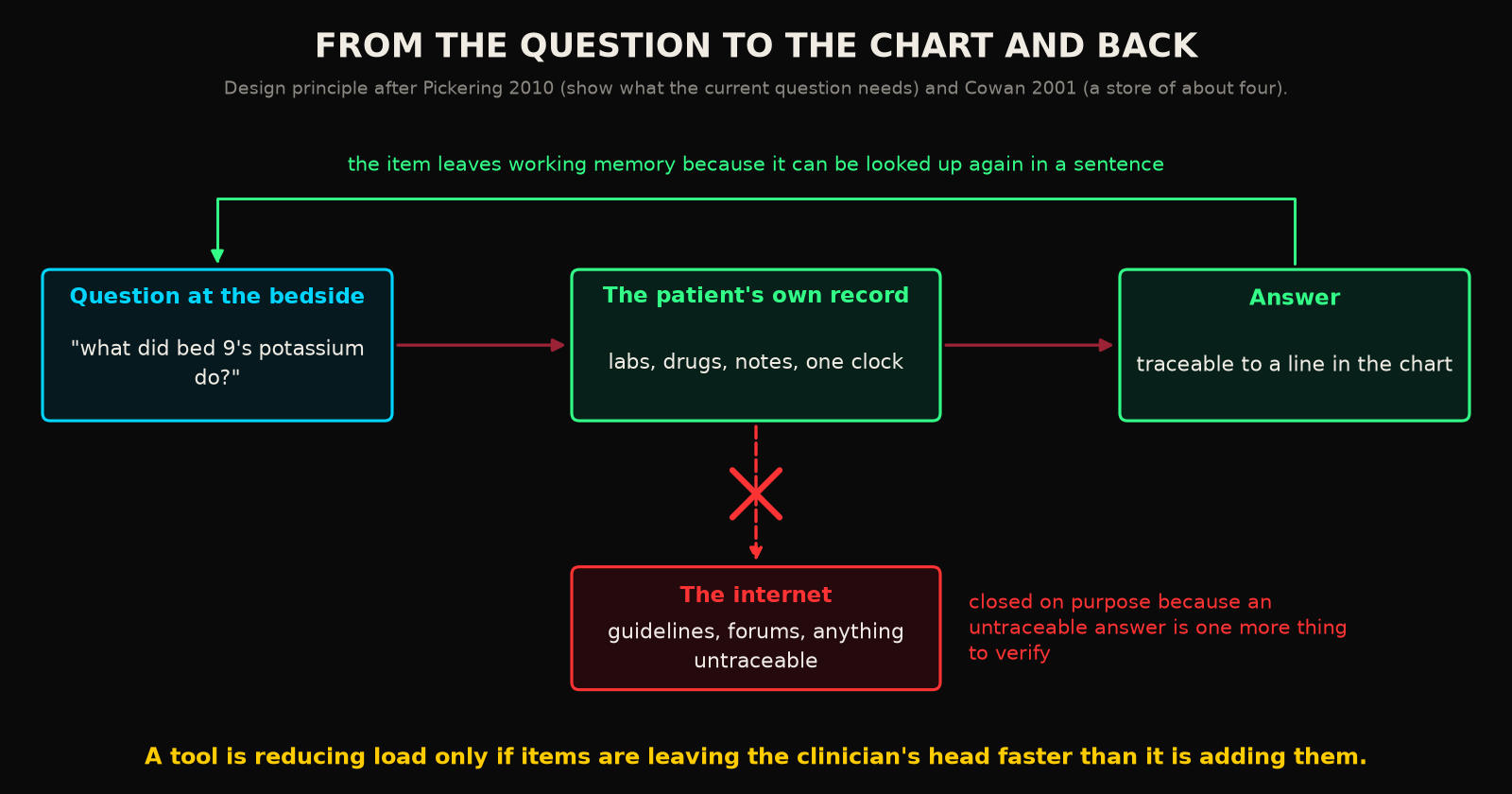
If adding things does nothing, what removes them? The cognitive literature has had the answer for a long time and the unit has been ignoring it. An item leaves working memory when it is written in the place where it will be needed, because then it can be looked up on demand and no longer has to be held. The Mayo group understood this in 2010, when they built an interface for their ICU with the stated aim of reducing information overload. The principle was that the clinician should be shown what the current question needs and nothing else9. The principle is older than the software. If you can ask a question about bed 9 and get the answer from bed 9's record, at the bedside, in the time it takes to ask it, you can walk to bed 4 without carrying bed 9's potassium with you.
Notice what that requires. The answer has to come from the patient's own record and nowhere else, because an answer with an unknown provenance is one more thing to verify, and verification takes a slot of its own. It has to be available where the decision is being made, which is at the bedside or on the phone in the corridor, and never only at a desktop at the station. It has to be the same record the nurse is writing into, so that the handover note, the trend and the question all point at one object. And it has to be fast. An answer that arrives after the resident has finished presenting is an interruption of its own.
That is what tachyDx Teams is built to be. Each patient in Teams has an assistant that answers plain questions from that patient's chart alone. Ask what the potassium did after the replacement and it reads the chart. Ask what the pressor dose has done since the afternoon and it reads the chart again. It does not read the internet. That is a decision (an answer that cannot be traced to a line in the record is a liability at 2 AM). The handover notes and the trends sit in the same place as the assistant, on a phone, so the object being discussed at bed 4 is the one object everyone on the team is looking at. An intensivist has been running it on her own phone since July. It is a bandwidth tool and nothing more. It does not estimate state, it does not compute where the patient is going, and it will not tell her that bed 9 is about to turn. It will tell her what bed 9's potassium was at 4 PM, so that she can stop holding it.
5The bottleneck was never the person
Go back to bed 4. The resident has finished. You caught most of it, and you will ask him to repeat the number you missed, and he will think you were not listening. You were listening. You were also holding a potassium, a pressor dose, a conversation and a scan result in a store that holds four. The fifth thing, the number, fell out, exactly as the literature says it will.
What would the unit look like if it took Cowan's four seriously? The monitor would be allowed to make fewer demands. The score would be shown when the question is asked and hidden when it is not. The potassium would be in the place you are standing, in the record, retrievable in a sentence. And the measure of a good tool would be how many items it removed from your head, which is a number no dashboard vendor has ever been asked for.
The intensivist was never the bottleneck. The bottleneck is asking a person to be a database.
RReferences
- 1.Cowan N. The magical number 4 in short-term memory: a reconsideration of mental storage capacity. Behav Brain Sci. 2001;24(1):87-114.
- 2.Cowan N. The magical mystery four: how is working memory capacity limited, and why? Curr Dir Psychol Sci. 2010;19(1):51-57.
- 3.Li L, Hains I, Hordern T, Milliss D, Raper R, Westbrook J. What do ICU doctors do? A multisite time and motion study of the clinical work patterns of registrars. Crit Care Resusc. 2015;17(3):159-166.
- 4.Drew BJ, Harris P, Zègre-Hemsey JK, et al. Insights into the problem of alarm fatigue with physiologic monitor devices: a comprehensive observational study of consecutive intensive care unit patients. PLoS One. 2014;9(10):e110274.
- 5.Park J, Zhong X, Dong Y, Barwise A, Pickering BW. Investigating the cognitive capacity constraints of an ICU care team using a systems engineering approach. BMC Anesthesiol. 2022;22(1):10.
- 6.Divatia JV, Mehta Y, Govil D, et al. Intensive care in India in 2018-2019: the second Indian intensive care case mix and practice patterns study (INDICAPS-II). Indian J Crit Care Med. 2021;25(10):1093-1107.
- 7.Gershengorn HB, Pilcher DV, Litton E, Anstey M, Garland A, Wunsch H. Association of patient-to-intensivist ratio with hospital mortality in Australia and New Zealand. Intensive Care Med. 2022;48(2):179-189.
- 8.Barger LK, Ayas NT, Cade BE, et al. Impact of extended-duration shifts on medical errors, adverse events, and attentional failures. PLoS Med. 2006;3(12):e487.
- 9.Pickering BW, Herasevich V, Ahmed A, Gajic O. Novel representation of clinical information in the ICU: developing user interfaces which reduce information overload. Appl Clin Inform. 2010;1(2):116-131.
Declarations
Competing interests. The author is the founder of Aethryva Deeptech, which develops the tachyDx platform and the MOISSCode language. Where an article in this series mentions either, it says so in the text and the mention follows the argument.
Sources and figures. Every reference in this article is an open access source that any reader can open without payment. The figures were drawn by the author from the values printed in those sources, or are labelled as schematic where no published value exists. No patient data were used.
Cite this article
Kunche N. A whole ICU does not fit in a working memory of about four items. The Intervention. 6 August 2026. https://nikhilkunche.com/blog/a-whole-icu-does-not-fit-in-a-working-memory-of-about-four-items
Comments