
It is the second week of the monsoon and the medical ICU has six dengue patients in a row. Bed four is a woman of thirty two. Her platelet count came back at fourteen thousand this morning, down from twenty six thousand yesterday. She has no bleeding. Her gums are fine, her urine is clear, her blood pressure has held all night. The laminated card at the nursing station carries the national guideline: transfuse platelets only if bleeding is present, and prophylactic transfusion may be considered below ten thousand1. Tomorrow the count will probably be nine thousand. The card will then say something different.
The intensivist on the round has seen four hundred of these. She knows, in the way four hundred cases produce knowing, that this patient will not bleed. The count will turn in forty eight hours. A unit of platelets will buy nothing except a transfusion reaction at 3 AM. The protocol does not know any of that. The protocol knows a threshold. The problem is that the audit form asks about the threshold, so she is choosing tonight between a transfusion she believes is useless and a blank on a form that someone in quality will circle in red. Four hundred patients of her own have no standing in that conversation. Basically the knowledge lives in her head. A head cannot be cited.
1The average was never her
Every protocol is an average. What I mean by that is, a protocol is the treatment that did best, on average, in the patients who were let into a trial. You might assume the door to a trial is wide. It is not. When a group reviewed 75 randomised trials published in critical care between 2018 and 2023, they counted 1,455 exclusion criteria, a median of nineteen per trial. They judged that 60 percent of the trials carried at least one exclusion that could not be justified2. The commonest unjustified exclusions were pregnancy and a communication barrier (which is to say, the patient who does not speak the research nurse's language). Across cardiology, mental health and oncology, 71 percent of the 52 studies that compared trial samples with real world patients concluded that the trial samples were not representative3.
The ICU version of that number is worse. In a French registry of 67,717 patients with severe sepsis and septic shock, 60 percent carried at least one of the exclusion criteria the sepsis trials commonly use. Congestive heart failure alone excluded 35 percent. Cancer excluded 30 percent4. Look down your own unit tonight. How many of those patients would the trial have let in? The patient with heart failure and the patient with cancer are the patients who fill the beds. The trial that wrote their protocol had never met them. The exclusion is rarely malicious, since a trial has to be feasible and a dying patient with three comorbidities is a hard patient to randomise. It is still an exclusion. The protocol that comes out of it carries no footnote saying so.
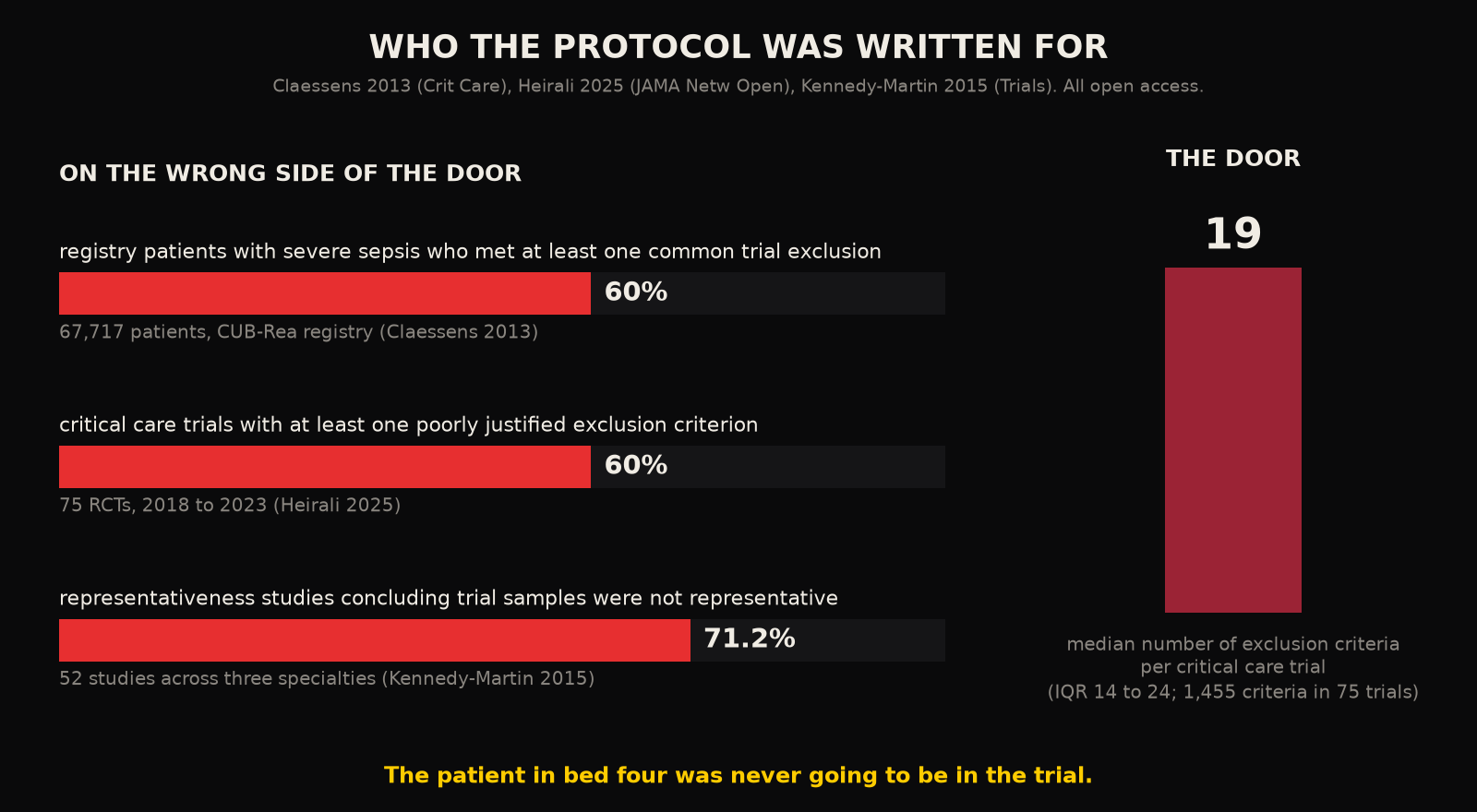
None of this is an argument against trials. It is an argument about what a trial result is. A trial result is a statement about the average member of a population assembled by exclusion, and the protocol then applies it to a patient who was probably excluded. Who decided that the average of patients who were not her is the right treatment for her tonight?
2The average hides the effect
Even inside the trial, the average is a blunt instrument. A therapy can be beneficial on average and consistently harmful to the low risk patients who met the enrolment criteria. A trial can be negative overall while the therapy consistently helps the sickest patients in it5. Both patterns have been published in critical care. Neither is visible in the single number a protocol is built from.
The sepsis bundle is the case every intensivist knows and few like to retell. In 2001, a single emergency department in Detroit randomised 263 patients to early goal directed therapy. It reported in hospital mortality of 30.5 percent against 46.5 percent for standard care6. Sixteen points, from one centre. That became the protocol for septic shock on every continent for the next decade. You were probably audited against it. When the protocol was finally tested against what experienced clinicians were already doing, across 56 hospitals in England, 90 day mortality was 29.5 percent with it and 29.2 percent without it. The protocol also cost more7. Pooled across five trials and 4,303 patients, early goal directed therapy had no survival benefit at all8. The 2001 average had been true of 263 people in Detroit. It was then applied, by instruction, to several million patients who were not them. The clinicians applying it were audited against it.
This is protocol medicine in its pure form. A number is derived from one population and enforced on another. The audit then treats compliance as evidence. What was lost in those ten years was never the protocol. It was the judgement of every clinician who looked at one particular patient and thought this is not going to help her. That thought had nowhere to go.
3The platelet that was never needed
Dengue is where this becomes concrete, because the bedside knowledge arrived years before the evidence and was never written down. The 2009 WHO guideline already said that prophylactic platelet transfusions in haemodynamically stable patients with severe thrombocytopenia have not been shown to be effective and are not necessary
9. Two years later the regional guideline for South East Asia suggested that prophylactic platelets could be considered below ten thousand. When dengue experts were then surveyed, their practice varied so widely that the authors titled the paper after the missing evidence base10. The experts disagreed with the guidelines. The guidelines disagreed with each other. The only people who actually knew were the clinicians who had watched hundreds of counts fall and recover without a bleed.
The evidence caught up. In Singapore, 788 adults with dengue, fewer than twenty thousand platelets and no bleeding were followed. Of those, 486 received a prophylactic transfusion11. Clinical bleeding occurred in 18.2 percent of the patients who were not transfused and 23.5 percent of those who were. Platelet recovery took two days without transfusion and three days with it. The median hospital stay was five days against six11. The 2023 national guideline now summarises the subsequent randomised trial in one line: prophylactic transfusion was not superior to supportive care in preventing bleeding and was associated with adverse events1.
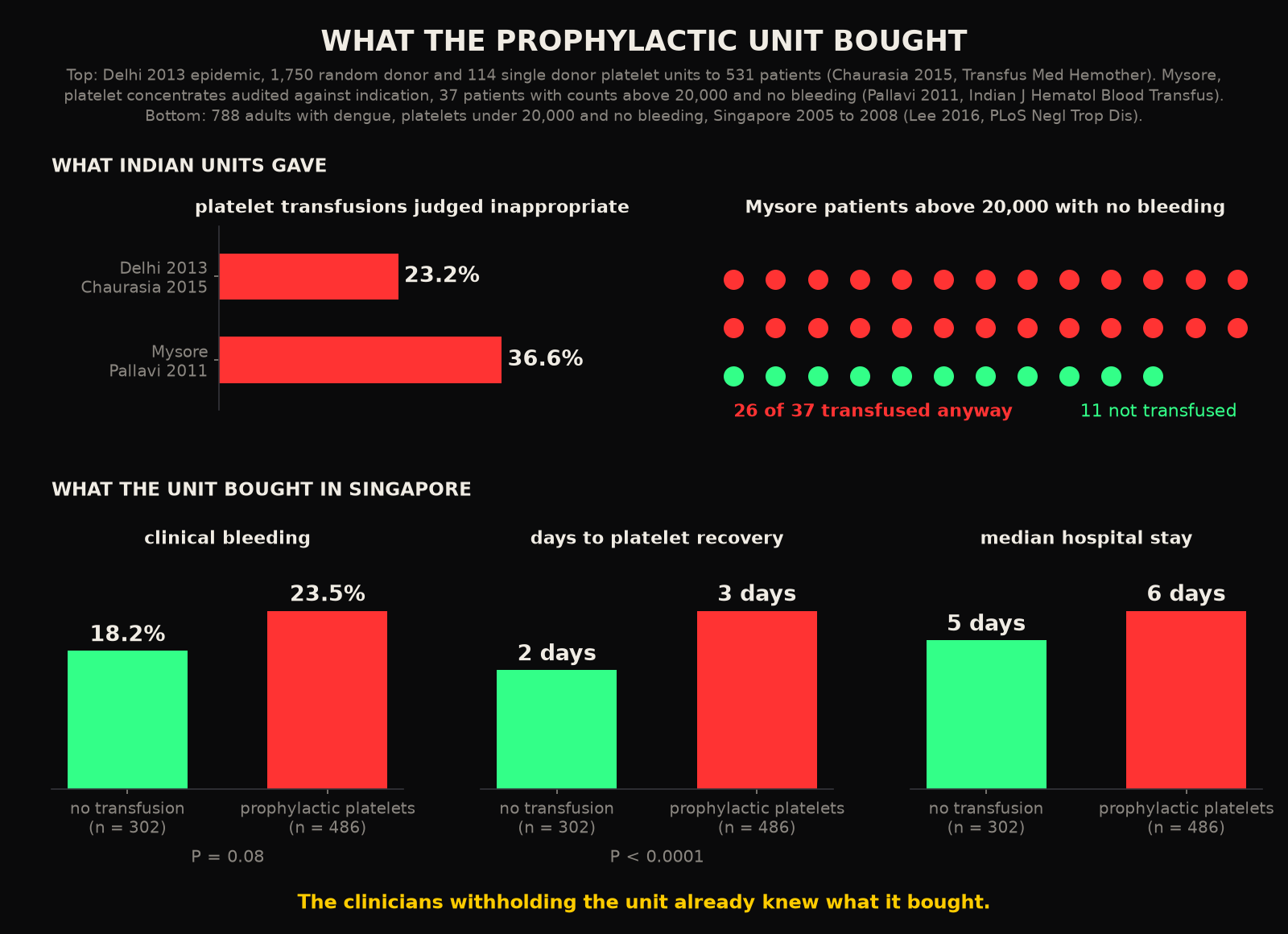
Meanwhile, on the wards, the threshold was being over applied. In the 2013 Delhi epidemic, 1,750 random donor and 114 single donor platelet units went to 531 patients. Of those transfusions, 23.2 percent were judged inappropriate against the national guidance12. In Mysore it was 36.6 percent, with 26 of 37 patients above twenty thousand transfused despite no bleeding13. Read those two audits beside the Singapore cohort. The shape of the problem is visible. The protocol was being applied too often by clinicians who had not seen enough dengue. It was being overridden quietly by clinicians who had. Neither group had a place to write down why.
4Why the exception is never written down
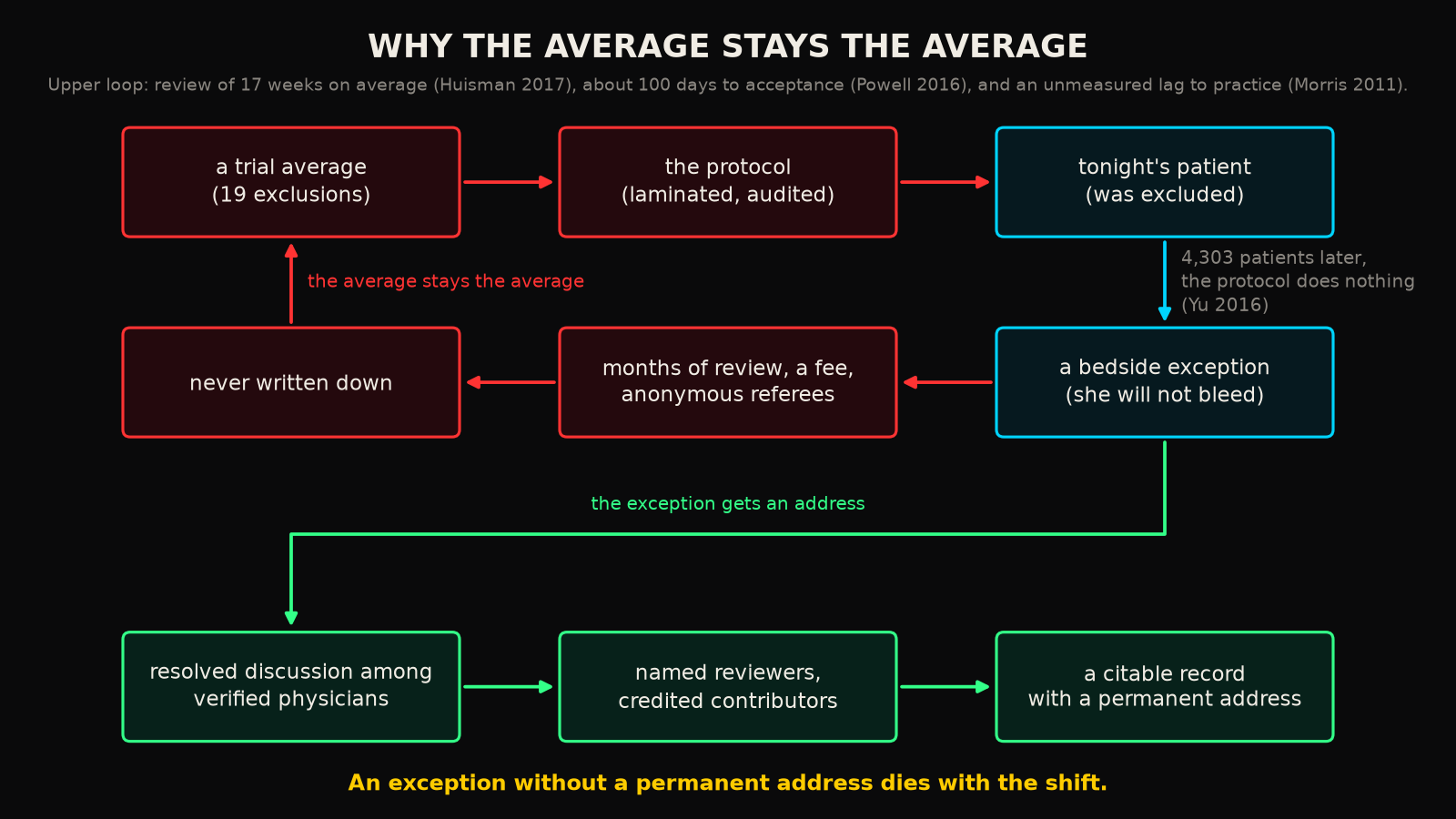
The intensivist in bed four could, in principle, write her four hundred cases up. Consider what that would cost her. Author reported data on roughly 3,500 submissions put the review time of an accepted manuscript at seventeen weeks on average, twelve in medicine. A third of journals take more than two weeks just to desk reject14. Across all of PubMed the median time from submission to acceptance has sat near a hundred days for years, and the wait is longer at the high profile journals15. Then there is a fee. Then there are two anonymous reviewers who may never have treated dengue. Then there is the question of whether a case series from a district ICU is publishable at all. She is working nights in the monsoon, with six dengue patients in a row and a quality form to fill (the form has a box for the threshold and no box for her). She will not write it. In twenty years of practice she has never written one.
The famous figure for how long evidence takes to reach practice is seventeen years. The paper that carries the number in its title found, on examination, 23 studies measuring different things at different points that could barely be compared16. The honest version is that the lag has never been measured properly, because the knowledge that would shorten it is mostly never submitted. The exceptions that would refine the protocol are generated every night in every ICU, by the people best placed to generate them. You generate several per shift. They are discarded at handover. This is exactly why the average stays the average, the next trial is built on the same exclusions, and the laminated card is reprinted.
5Giving the exception an address
This is the problem the tachyDx Research Portal was built for. A clinical question is raised and argued through among verified physicians. When the discussion resolves, the resolved thread becomes a citable paper with a digital object identifier, the reviewers named on the page and every contributor credited, and the passage from question to record is measured in days. The intensivist's four hundred dengue patients, or the one in bed four, can then exist somewhere other than her head, with her name on the observation and the names of the colleagues who checked it, at an address the next clinician and the next guideline committee can read. The point is the address. An exception with a permanent address is evidence. An exception without one is an anecdote that dies with the shift.
A citable case is evidence about one patient, and the paper says so. It is a brick. The protocol is the wall.
Back in bed four, the count will fall to nine thousand tomorrow. The card will change its mind. The intensivist will decide again, with four hundred cases behind her and no way to show them. Tonight's patient is being treated by the average of patients who were not her, until the people who have seen her kind can be read.
RReferences
- 1.National Center for Vector Borne Diseases Control, Ministry of Health and Family Welfare, Government of India. National guidelines for clinical management of dengue fever. New Delhi; 2023.
- 2.Heirali A, et al. Eligibility criteria of randomized clinical trials in critical care medicine. JAMA Netw Open. 2025;8(1):e2454944.
- 3.Kennedy-Martin T, Curtis S, Faries D, Robinson S, Johnston J. A literature review on the representativeness of randomized controlled trial samples and implications for the external validity of trial results. Trials. 2015;16:495.
- 4.Claessens YE, Aegerter P, Boubaker H, Guidet B, Cariou A; CUB-Rea Network. Are clinical trials dealing with severe infection fitting routine practices? Insights from a large registry. Crit Care. 2013;17(3):R89.
- 5.Iwashyna TJ, Burke JF, Sussman JB, Prescott HC, Hayward RA, Angus DC. Implications of heterogeneity of treatment effect for reporting and analysis of randomized trials in critical care. Am J Respir Crit Care Med. 2015;192(9):1045-1051.
- 6.Rivers E, Nguyen B, Havstad S, et al. Early goal-directed therapy in the treatment of severe sepsis and septic shock. N Engl J Med. 2001;345(19):1368-1377.
- 7.Mouncey PR, Osborn TM, Power GS, et al. Protocolised Management In Sepsis (ProMISe): a multicentre randomised controlled trial of the clinical effectiveness and cost-effectiveness of early, goal-directed, protocolised resuscitation for emerging septic shock. Health Technol Assess. 2015;19(97):1-150.
- 8.Yu H, Chi D, Wang S, Liu B. Effect of early goal-directed therapy on mortality in patients with severe sepsis or septic shock: a meta-analysis of randomised controlled trials. BMJ Open. 2016;6(3):e008330.
- 9.World Health Organization. Dengue: guidelines for diagnosis, treatment, prevention and control. New edition. Geneva: WHO; 2009.
- 10.Whitehorn J, Rodriguez Roche R, Guzman MG, et al. Prophylactic platelets in dengue: survey responses highlight lack of an evidence base. PLoS Negl Trop Dis. 2012;6(6):e1716.
- 11.Lee TH, Wong JG, Leo YS, et al. Potential harm of prophylactic platelet transfusion in adult dengue patients. PLoS Negl Trop Dis. 2016;10(3):e0004576.
- 12.Chaurasia R, Zaman S, Chatterjee K, Das B. Retrospective review of platelet transfusion practices during 2013 dengue epidemic of Delhi, India. Transfus Med Hemother. 2015;42(4):227-231.
- 13.Pallavi P, Ganesh CK, Jayashree K, Manjunath GV. Unfurling the rationale use of platelet transfusion in dengue fever. Indian J Hematol Blood Transfus. 2011;27(2):70-74.
- 14.Huisman J, Smits J. Duration and quality of the peer review process: the author's perspective. Scientometrics. 2017;113(1):633-650.
- 15.Powell K. Does it take too long to publish research? Nature. 2016;530(7589):148-151.
- 16.Morris ZS, Wooding S, Grant J. The answer is 17 years, what is the question: understanding time lags in translational research. J R Soc Med. 2011;104(12):510-520.
Declarations
Competing interests. The author is the founder of Aethryva Deeptech, which develops the tachyDx platform and the MOISSCode language. Where an article in this series mentions either, it says so in the text and the mention follows the argument.
Sources and figures. Every reference in this article is an open access source that any reader can open without payment. The figures were drawn by the author from the values printed in those sources, or are labelled as schematic where no published value exists. No patient data were used.
Cite this article
Kunche N. ICU protocols are tuned to the average patient of someone else's trial. The Intervention. 24 September 2026. https://nikhilkunche.com/blog/icu-protocols-are-tuned-to-the-average-patient-of-someone-elses-trial
Comments