
A patient is admitted to the ICU with suspected sepsis. The attending orders blood cultures, lactate, and broad-spectrum antibiotics. The antibiotics are started within the first hour. This is good. The Surviving Sepsis Campaign guidelines recommend antibiotics within one hour of recognition.
But recognition is the problem.
The patient has been deteriorating for hours before anyone recognized the sepsis. The lactate was 1.8 at the ED. Normal. Nothing to flag. Four hours later, a routine ICU lab draw comes back: lactate 3.6. The nurse pages the resident. The resident orders a repeat in two hours. Two hours later: lactate 5.1. Now they call the attending. Now they start the antibiotics.
Between the first normal lactate and the first dose of antibiotics, six hours passed. During those six hours, the patient's trajectory was computable. The velocity of lactate increase was detectable at hour 2. The acceleration was detectable at hour 4. The trajectory predicted crossing the infection-to-organ-damage threshold at hour 6. The intervention window, the period during which antibiotics would prevent the cascade from becoming irreversible, was hours 2 through 5.
The antibiotics arrived at hour 6. One hour after the window closed.
The patient survived. With three weeks in the ICU, a tracheostomy, and a kidney that will never fully recover. If the antibiotics had arrived three hours earlier, during the computable window, the outcome would have been different. Maybe two days in the ICU. Maybe no tracheostomy. Maybe kidneys that go home working.
Three computable hours, invisible to the monitoring system: this is the timing problem.
1The window exists
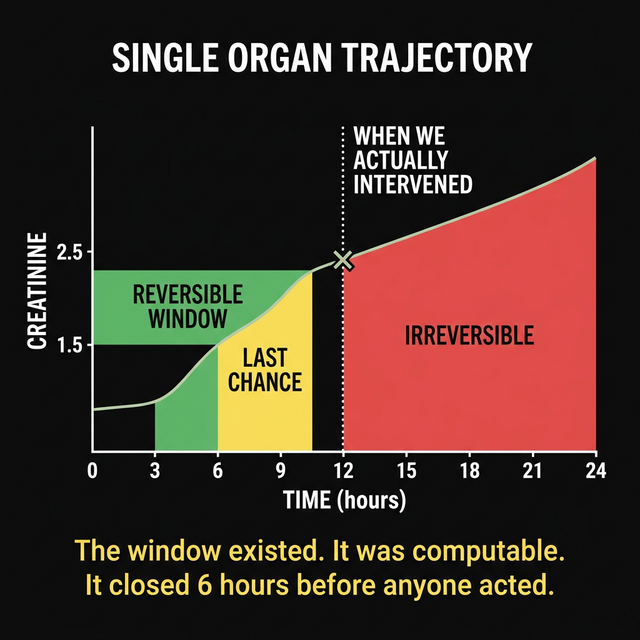
For every organ system, for every mode of failure, there exists a window of intervention. A period during which the right action changes the trajectory from irreversible damage to recovery.
For sepsis, the window begins when the inflammatory cascade transitions from a localized response to a systemic one. The transition has a signature in the biomarker trajectories: lactate velocity inflects, inflammatory markers couple to organ function markers, and the cross-biomarker coherence changes in a specific pattern. The transition typically occurs 2 to 4 hours before any single biomarker crosses a conventional alarm threshold. The window closes when the cascade reaches a tipping point where the organ damage becomes self-sustaining even after the source infection is controlled.
For acute kidney injury, the window is between the onset of tubular stress (detectable in urinary biomarkers like NGAL and KIM-1 before creatinine rises) and the establishment of necrotic injury. This window is typically 4 to 8 hours. Once necrotic injury is established, the kidney may recover, but the recovery timeline extends from days to weeks, and some functional loss becomes permanent.
For respiratory failure, the window is between the onset of inflammatory alveolar damage (detectable in ventilatory mechanics and gas exchange trends before imaging changes) and the establishment of fibroproliferative ARDS. Early intervention (prone positioning, optimized PEEP, reduced driving pressure) during this window changes the trajectory. Late intervention, after fibroproliferation is established, has markedly reduced efficacy.
These windows are real. They are physiologically grounded. They are documented in the critical care literature, sometimes in case series, sometimes in retrospective analyses of patients who received early versus late intervention. The concept of the window is not controversial. What is controversial, or rather what is simply not done, is computing the window in real time for each patient.
2Open-loop medicine
Control theory distinguishes between open-loop and closed-loop control.
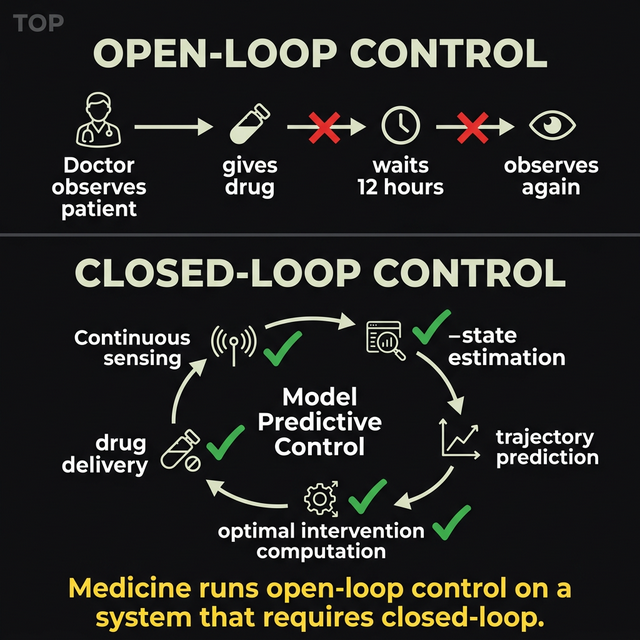
Open-loop control: apply an input, wait, observe the output, decide what to do next. The controller acts, then waits for the result. During the waiting period, the system evolves unobserved. The next action is based on whatever state the system has reached by the time the next observation arrives.
Closed-loop control: continuously observe the system, continuously compute the optimal input, continuously adjust. The controller never stops watching. The correction is computed and applied at a rate fast enough to track the system's dynamics.
Medicine runs open-loop control on ICU patients.
The attending rounds in the morning. Assesses the patient. Makes a plan: continue antibiotics, adjust the vasopressor, order a CT at noon. Then the attending moves to the next patient. For the next 4 to 6 hours, the plan is the plan. If the patient's trajectory changes during those hours (and it will), the change may not be detected until the next round of labs, the next nursing assessment, or the next time someone looks at the vital signs and notices a trend.
The nurse is closer to the patient. The nurse watches the vital signs continuously (sort of: the monitor displays numbers, alarms fire on thresholds, and the nurse checks periodically between other tasks). But the nurse is not computing trajectories. The nurse sees: MAP 62 right now. Heart rate 112 right now. SpO2 94 right now. The nurse does not see: MAP trajectory predicts crossing 55 in 90 minutes at current vasopressor dose. Heart rate acceleration suggests inadequate volume resuscitation. SpO2 trend predicts desaturation requiring reintubation within 4 hours if FiO2 is not adjusted.
The information to compute these predictions exists in the monitor. The monitor records every data point. It simply does not compute the trajectory or predict the future. It shows the present and alarms on the past (thresholds already crossed). By the time the alarm fires, the window may have closed.
3Timing is everything
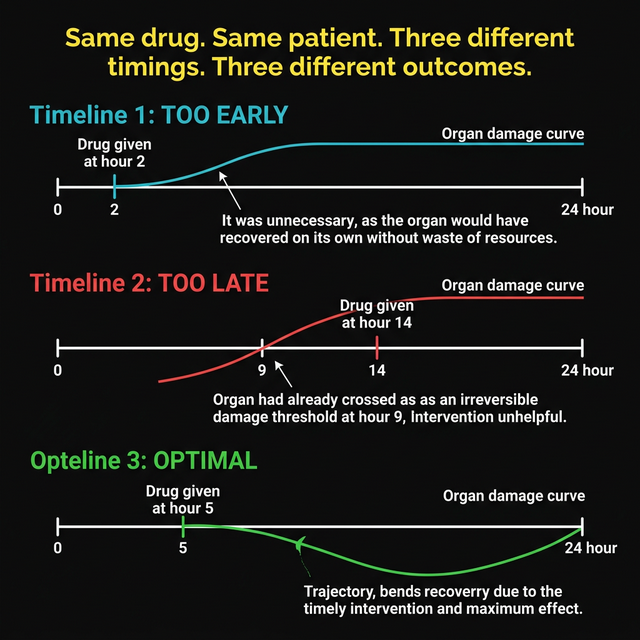
The same drug, given to the same patient, at three different times, produces three different outcomes.
Too early: the drug is given before the trajectory indicates it is necessary. The organ might have recovered on its own. The drug exposure was unnecessary. The side effects (nephrotoxicity, hepatotoxicity, antibiotic-driven resistance selection) were incurred for no benefit. This is the cost of over-intervention, and it is not zero. Unnecessary broad-spectrum antibiotics alter the microbiome, select for resistant organisms, and can cause Clostridioides difficile colitis. Unnecessary vasopressors cause peripheral ischemia. Unnecessary fluids cause volume overload and pulmonary edema.
Too late: the drug is given after the organ has crossed the irreversible threshold. The antibiotics clear the infection, but the organ damage is established. The intervention cannot undo what has already happened. The patient survives (maybe) with permanent functional loss. The kidney needs dialysis. The lung needs prolonged ventilation. The neurological deficit is permanent. This is the cost of under-intervention, and it is measured in disability, in ICU days, in quality of life years lost.
Optimal: the drug is given during the window. The trajectory is bending toward the threshold but has not crossed it. The drug alters the dynamics: the infection source is controlled, the inflammatory cascade decelerates, the organ function stabilizes and begins to recover. The patient spends 2 days in the ICU instead of 3 weeks. The kidney goes home working. No tracheostomy.
The difference between these three scenarios is the timing, not the drug, the dose or the diagnosis. And the timing is computable from the trajectory.
4Model predictive control
There is a framework for this. It is called Model Predictive Control (MPC).
MPC works like this: at every time step, use the current state estimate to predict the future trajectory. Search over possible interventions (drug choices, doses, timing). For each candidate intervention, simulate the predicted trajectory. Select the intervention that optimizes the predicted outcome over a defined horizon. Apply the first step of the optimal intervention. At the next time step, update the state estimate with new measurements, and repeat.
This is how autonomous systems work. It is how a self-driving car avoids obstacles: predict where everything will be in 3 seconds, compute the steering and braking that avoids collision, execute the first 100 milliseconds of that plan, then recompute.
It is how process control maintains a chemical reactor at its operating point: predict where the temperature and pressure will be in 10 minutes, compute the cooling and flow adjustments that keep the system in bounds, execute, observe, and repeat.
It is how spacecraft are navigated: predict the trajectory under current thrust, compute the correction that achieves the target orbit, execute, observe the new state, and repeat.
For an ICU patient, MPC would look like this: given the current organ function trajectories (computed by the state estimator using reliable sensor data), predict the organ function trajectories over the next 6 to 12 hours under the current treatment plan. If any trajectory is predicted to cross a critical threshold during that horizon, compute the intervention (drug, dose, timing) that prevents the crossing with minimum side effects. Display the recommendation to the clinician with the predicted trajectory and the confidence interval. If the clinician accepts, execute. At the next state update, repeat.
This is standard control theory. The mathematics has been published since the 1960s. The computational methods have been practical since the 1990s. The hardware requirements are modest. The clinical information needed to build the models exists in the literature and in the data. What does not exist is the integration: the sensor layer that feeds reliable trajectory data to the state estimator, the state estimator that computes the full state, and the controller that uses the state to compute optimal intervention timing.
5The gap
The gap is not intellectual, because the people in the ICU are brilliant. The attendings who manage 15 critically ill patients simultaneously are performing one of the most cognitively demanding tasks in medicine. The nurses who detect subtle changes in a patient's status through pattern recognition honed over years of experience are doing something remarkable.
The gap is structural. The monitoring infrastructure was designed to measure and alarm. It was not designed to estimate, predict, and optimize. The mathematical tools to fill this gap exist. They are deployed in every other discipline that manages coupled dynamical systems under uncertainty. The engineering is undergraduate-level control theory applied to a domain where the stakes are measured in human lives, not science fiction.
The 3-hour window exists for every patient, for every organ system, for every mode of failure. It is computable from the trajectory. The trajectory is estimable from the measurements. The measurements are improvable with adaptive filtering. The intervention timing is optimizable with model predictive control.
Every piece of this pipeline exists. It has existed for decades. The gap is in what we have built, not in what we know. The patients are waiting for engineering to catch up with the mathematics.
The window opens. The window closes. The clock does not care about our institutional inertia. It does not wait for grant funding or regulatory clearance or consensus guidelines. It ticks. The trajectory moves. The threshold approaches.
Three computable hours that the most expensive monitoring system in the world cannot see.
Yet.
Declarations
Competing interests. The author is the founder of Aethryva Deeptech, which develops the tachyDx platform and the MOISSCode language. Where an article in this series mentions either, it says so in the text and the mention follows the argument.
Sources and figures. This article argues from first principles and from the author's own published work, and carries no reference list. Figures are schematic. Articles in the series from April 2026 onward cite open access sources only.
Cite this article
Kunche N. The 3-hour window: intervention timing is a control theory problem. The Intervention. 8 March 2026. https://nikhilkunche.com/blog/the-3-hour-window
Comments