
There is a system sitting in a room right now. It occupies a position in a high dimensional state space. It has velocity. It has acceleration. Multiple subsystems are coupled to each other through nonlinear interaction terms. External inputs are being applied with their own time-varying dynamics. The system has threshold boundaries: cross one, and the dynamics change irreversibly. The state vector has at least 20 components, several of which are not directly observable and must be inferred from noisy, intermittent measurements.
An engineer would recognize this immediately. This is a standard state estimation problem. Track the position, compute the velocity, estimate the coupling terms, predict the trajectory, identify when the system is approaching a critical boundary, and compute the optimal control input to prevent the crossing. Kalman filters do this. Aerospace systems do this routinely, tracking 50-state vectors in real time with noisy radar measurements.
The system is an ICU patient.
The position is the current value of each organ's function. The velocity is the rate of change. The coupling terms are the interactions between organ systems: kidney function affecting drug clearance, drug clearance altering hepatic load, hepatic function modulating coagulation, coagulation influencing hemodynamics. The external inputs are interventions: antibiotics, vasopressors, fluids, ventilation. Each has its own pharmacokinetic time profile. The critical boundaries are the thresholds beyond which organ damage becomes irreversible.
Nobody in the ICU is computing any of this: the state vector is not tracked, the velocity is not computed, the coupling terms are not modeled, the trajectory is not predicted, the proximity to critical boundaries is not measured, and the interventions are not timed by computation. They are timed by intuition, experience, and protocols that were designed without any reference to the dynamical properties of the system they are trying to control.
1The photograph problem
Imagine trying to land a spacecraft by photographing its position once every 12 hours.
You take a picture at hour 0. The spacecraft is here. You take another picture at hour 12. The spacecraft is there. You compute the distance it traveled. You estimate the average velocity. You have no idea what happened between the two photographs. Did it accelerate? Decelerate? Change direction? Pass through a region of high gravitational perturbation? Almost collide with debris at hour 6 before drifting back to its observed position at hour 12?
No aerospace engineer would attempt this. The idea is absurd. Spacecraft require continuous tracking, real-time velocity estimation, gravitational field modeling, trajectory prediction, and computed course corrections. The mathematical frameworks to do this have existed since the 1960s. Kalman published his filter in 1960. Apollo used it to reach the Moon in 1969.
Medicine photographs the patient every 12 hours and calls it monitoring.
A blood draw at 3 AM. Results at 5 AM. Another blood draw at 3 PM. Results at 5 PM. Between those two photographs, the patient traversed a trajectory through a state space that nobody observed. The information lives in the trajectory and dies in the photographs.
2Phase space
There is a concept in dynamical systems theory that makes the photograph problem precise. Phase space.
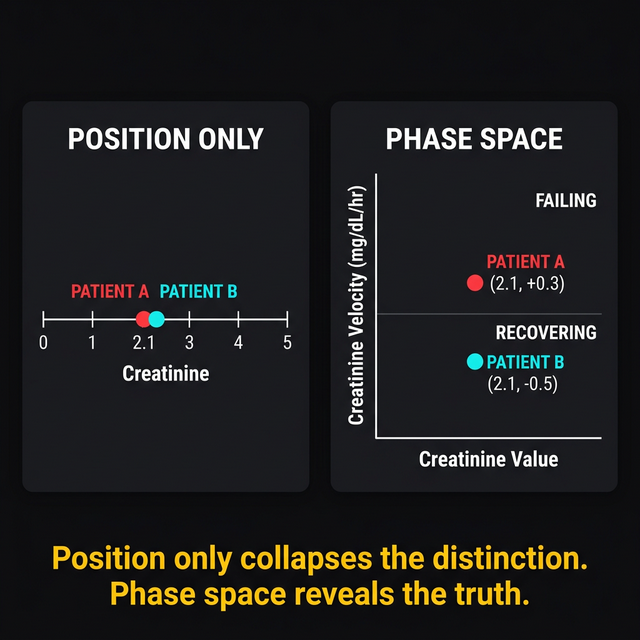
When you measure a creatinine value of 2.1, you have a position. You know where the kidney is on a single axis. Two patients can have the same position. Patient A has creatinine 2.1, rising from 0.9 over two days. Patient B has creatinine 2.1, falling from 4.6 over three days. In position space (the number line), they are indistinguishable. In phase space (position plus velocity), they are in completely different locations.
Patient A occupies a point in the upper right quadrant of creatinine phase space: value elevated, velocity positive. This point corresponds to a kidney in active failure. The trajectory from this point leads toward higher creatinine values unless an intervention changes the dynamics.
Patient B occupies a point in the lower right quadrant: value elevated, velocity negative. This point corresponds to a kidney in recovery. The trajectory from this point leads toward normalization. The optimal action is fundamentally different.
Medicine collapses phase space to position space and calls it a lab result. The velocity dimension is discarded. The distinction between failure and recovery is invisible. The clinician has to reconstruct the velocity mentally by remembering the previous value and computing the direction in their head. For one parameter, this is manageable. For 20 parameters across 15 patients with values arriving at staggered times from a central lab that is hours behind real time, it is impossible.
3Coupled oscillators
No organ system operates in isolation. They are coupled oscillators.
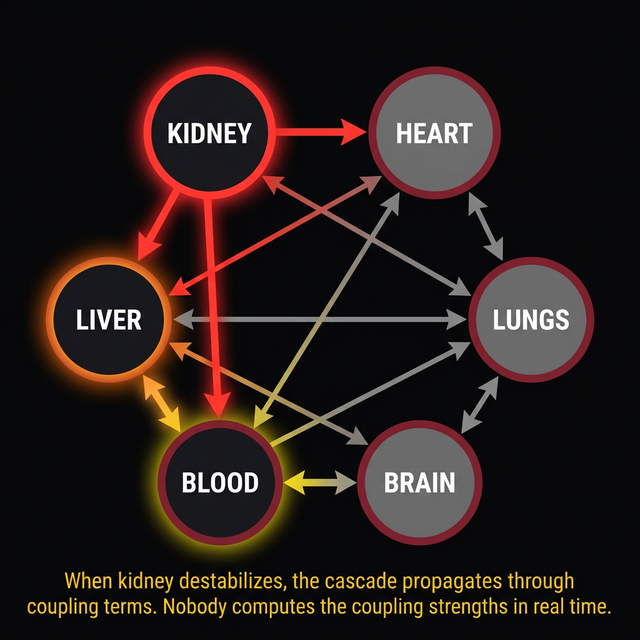
When the kidney begins to fail, creatinine rises. That is the number everyone watches. What they do not compute is the second-order effect: the kidney clears a significant fraction of administered drugs. As renal clearance drops, drug concentrations change. Aminoglycosides accumulate to nephrotoxic levels, accelerating the very renal failure they were meant to treat. Vancomycin trough levels climb. The dose that was therapeutic yesterday is toxic today, and nobody recomputed it because nobody is tracking drug clearance as a function of renal trajectory in real time.
The hepatic system compensates initially, metabolizing what the kidney cannot clear. But there is a limit. Once the liver is handling its own metabolic load plus the surplus from the failing kidney, its own function begins to degrade. Bilirubin rises. Coagulation factors that depend on hepatic synthesis start declining. INR increases. The patient begins to bleed.
The bleeding shifts the hemodynamic picture. Volume loss, even subclinical, changes cardiac preload. The heart compensates with increased rate and contractility. Vasopressor requirements change. The MAP that was stable at a given norepinephrine dose now requires more drug to maintain.
This is one event, which begins when one kidney starts failing. The cascade propagates through coupling terms to every other organ system in the body. The coupling strengths are measurable. The propagation dynamics are predictable. The timeline is computable. Nobody computes any of it.
Instead, the nephrologist looks at creatinine. The hepatologist looks at bilirubin. The hematologist looks at INR. The cardiologist looks at MAP and vasopressor dose. Each specialist sees their organ's position. Nobody sees the coupling. Nobody computes the cascade dynamics. Nobody predicts where the system will be in 6 hours given the current coupling strengths and trajectory.
Six specialists watch six independent numbers while the patient is one coupled dynamic system, and the gap between those two representations is where patients die.
4The potential landscape
Think of each organ's function as a ball sitting in a potential well. When the organ is healthy, the ball sits at the bottom of a deep well. Small perturbations (a transient drop in perfusion, a brief drug exposure) push the ball up the wall of the well, but gravity pulls it back. This is resilience. This is what a healthy organ does: it absorbs perturbations and returns to baseline.
As the organ deteriorates, it is as if the ball climbs higher up the wall. The restoring force weakens. Perturbations that would have been absorbed now push the ball further. The response time lengthens. The oscillations around equilibrium grow in amplitude. These are the early warning signals that the system is approaching a critical transition.
At the rim of the well, there is a critical threshold. If the ball crosses the rim, it rolls into a different basin. Irreversible. Acute tubular necrosis. Hepatorenal syndrome. Ischemic bowel. The organ crosses into a regime where the dynamics are qualitatively different, where recovery requires a different kind of intervention (dialysis, transplant, surgical resection) or is not possible at all.
The clinical question is always: where is the organ relative to the rim? How fast is it moving toward the rim? How much restoring force remains? And critically: will the intervention (the antibiotic, the fluid bolus, the vasopressor) apply enough force to push the ball back down before it reaches the rim?
This is a computable question. The position of the ball is measurable (organ function values). The velocity is computable (from sufficiently sampled measurements). The shape of the potential well is estimable (from the system's response to previous perturbations). The critical threshold is identifiable (from the acceleration patterns that precede threshold crossing).
Nobody computes any of this. Nobody even frames the question this way. The clinical question gets asked in threshold language: is the creatinine above 2.0? Is the bilirubin above 3.0? Is the MAP below 65? These are position-only questions about a dynamical system that requires trajectory-level answers.
5Why engineers solve this daily
Everything described above, every concept, every mathematical framework, every computational approach, is standard engineering practice. It has been for decades.
Aerospace engineers track spacecraft through 50-dimensional state spaces in real time. They estimate velocity from noisy radar measurements. They model gravitational coupling between multiple celestial bodies. They predict trajectories hours and days into the future. They compute optimal correction maneuvers and time them to minimize fuel consumption while hitting the target. They do this with sensors that are noisy, measurements that arrive at irregular intervals, and system dynamics that are nonlinear and coupled. The Kalman filter, extended Kalman filter, unscented Kalman filter, particle filters: these are the tools. They are taught in undergraduate engineering courses. They are deployed in every navigation system on the planet.
Process control engineers maintain chemical reactors with hundreds of coupled variables at specific operating points. The reactor temperature, pressure, concentration, and flow rate are all coupled. A change in one affects all others. The control system tracks all of them simultaneously, predicts destabilizations before they occur, and adjusts inputs to maintain the system within safe operating boundaries. No chemical engineer would attempt to control a reactor by checking the temperature every 12 hours and adjusting the heat input based on intuition.
Autonomous vehicle systems fuse data from lidar, radar, cameras, and IMUs at millisecond timescales. They track the positions and velocities of dozens of surrounding objects simultaneously. They predict collision trajectories and compute avoidance maneuvers in real time. The computational infrastructure runs on hardware that costs less than a single ICU lab panel.
The mathematics is the same. State estimation. Trajectory prediction. Optimal control. Coupled dynamical systems. Threshold detection. Sensor fusion. The engineering disciplines solved these problems decades ago and deploy the solutions routinely in systems where failure means loss of life.
Medicine has a system where failure means loss of life. Medicine does not use these solutions. The most sophisticated monitoring in the most expensive unit in the most advanced hospital in the world is a collection of threshold alarms on snapshot measurements of independent parameters, checked by a human who has to integrate everything in their head because nobody built the computational layer that engineers consider basic infrastructure.
6The question nobody asks
How did we get here?
Through framing, not through malice or negligence. ICU monitoring was framed from the beginning as a measurement problem, not an estimation problem. The goal was to measure values accurately. It was never framed as: measure values, compute trajectories, estimate the full state, model the coupling, predict the future, and optimize the intervention timing.
Once you frame the problem as measurement, every improvement is about better sensors, faster labs, more parameters, higher precision. And all of these improvements feed into a system that still presents the clinician with a list of numbers. Better numbers. More numbers. Faster numbers. But they are still just numbers, positions without velocities, snapshots without trajectories, photographs without motion.
The patient is a trajectory through a state space so high dimensional that no human can visualize it, so nonlinear that intuition fails at the boundaries, so coupled that single-organ reasoning guarantees missing the cascade that kills, not a photograph.
The mathematics exists to track these trajectories and so does the hardware; the question is whether medicine is willing to stop photographing the patient and start tracking the trajectory.
Every discipline that tracks coupled dynamical systems under uncertainty in real time does it the same way: state estimation. Every discipline except the one where the system in question is a human being and the cost of failure is measured in lives.
The tools are in the textbooks, the mathematics is in the journals, the hardware is on the shelf, and the patients are in the ICU.
The gap between what engineering knows and what medicine does is measured in decades, in papers unread across disciplines, in tools undeployed, in trajectories untracked.
And in that gap, patients cross thresholds that nobody computed, following trajectories that nobody predicted, in a system that nobody modeled, toward outcomes that engineering could have changed.
Declarations
Competing interests. The author is the founder of Aethryva Deeptech, which develops the tachyDx platform and the MOISSCode language. Where an article in this series mentions either, it says so in the text and the mention follows the argument.
Sources and figures. This article argues from first principles and from the author's own published work, and carries no reference list. Figures are schematic. Articles in the series from April 2026 onward cite open access sources only.
Cite this article
Kunche N. Medicine is treating a dynamic system as if it were a photograph. The Intervention. 8 March 2026. https://nikhilkunche.com/blog/your-patient-is-a-dynamic-system
Comments